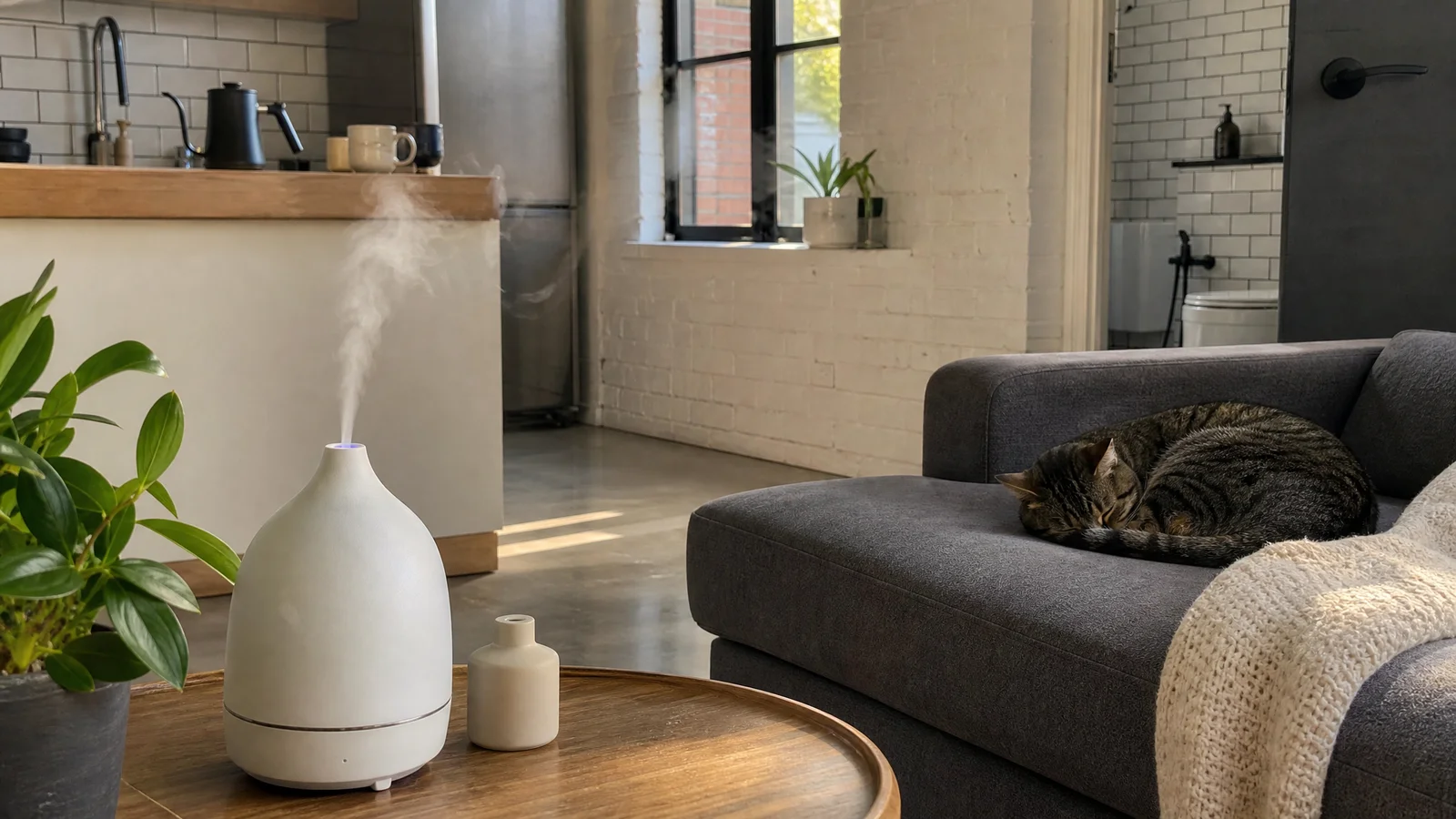
Diffusing Lemon Eucalyptus Oil: Ventilation, Pets and Timing
Diffuse lemon eucalyptus oil sparingly, for short sessions, in a room with the door open so that people and pets can leave. Keep the diffuser out of reach, skip it entirely if you have birds, and ask a veterinarian first if a pet has breathing problems. We sell the oil for scent only, not as an air or health product.

Lemon Eucalyptus Essential Oil
Our own Lemon Eucalyptus Essential Oil, in sizes from 0.5 oz to bulk.
From $9.99
Shop Now →Most diffusing advice is written for people and then adds a footnote about pets. For a household with a cat, a dog or a bird, the footnote is the main part. This guide starts with the animals and works back to the scent, because that is the order in which the decisions actually matter.
Two housekeeping points first. We sell lemon eucalyptus essential oil, bottled 100% pure and undiluted, from Corymbia citriodora leaf. Our shop page says to keep it away from eyes, children and pets and not to take it internally. And we do not claim that diffusing it cleans the air, repels insects or supports any condition; our stance page says it is not a registered repellent. We are describing a fragrance habit, and how to make it less risky.
What the pet sources say, and what they do not
We read three sources for this section. Here is what each one actually says, so you can judge for yourself.
| Source | What it says |
|---|---|
| ASPCApro, "Are Essential Oils Dangerous to Pets?" | Do not use an essential oil diffuser in the house if birds are present; keep diffusers and warmers out of pets' reach; birds are more likely to suffer respiratory effects from diffusers; generally, oral and dermal exposure are more concerning than inhalation; cats, rabbits, guinea pigs and hamsters may be more sensitive to dermal exposure |
| ASPCA, "Is the Latest Home Trend Harmful to Your Pets?" (January 17, 2018) | In concentrated form (100%) essential oils can be a danger for pets; using a diffuser for a short time in a secured area is not likely to be an issue; avoid diffusers if a pet has a history of breathing problems; avoid them where birds live; place the unit where a pet cannot knock it over |
| Pet Poison Helpline, "Updates on Essential Oils" (Kia Benson, DVM) | Passive diffusers such as reed diffusers and candles emit no actual droplets of oil; active diffusers release microdroplets or particles into the air; those droplets may collect on a pet's fur; cats lack a liver enzyme that makes it hard to metabolize and eliminate essential oils |
Read together, the sources point in one direction and also disagree on tone. ASPCA's 2018 piece is relaxed about short sessions in a secured area. The ASPCApro page (undated, copyright 2025) is stricter on birds and on skin exposure. Neither gives a number of minutes or drops, and we will not invent one. Where this article gives practical advice beyond what those sources say, we label it as our reasoning.
Why fur matters more than the air
The Pet Poison Helpline point about microdroplets collecting on fur is the one we would build a house rule around, along with the ASPCApro statement that oral and dermal exposure are generally more concerning than inhalation. A cat grooms. If oil lands on fur, the animal's own tongue becomes the route into the body. That is why the pet conversation is less about how strong the room smells and more about what the animal might touch, lick or lie in. Our reasoned consequences:
- Do not run an active diffuser right beside a pet's bed, crate or favorite perch.
- Wipe up any spilled oil or condensate, since a puddle on a floor is a bigger issue than vapor.
- If you notice a pet licking or rubbing at its coat after a diffusing session, stop and call your veterinarian.
For a dog-specific and cat-specific read, our existing piece on lemon eucalyptus oil around dogs and cats collects the questions owners ask, and the dog and cat guides for dogs and for cats go further. In every case, a veterinarian who knows your animal outranks a general article.
Ventilation: our reasoning, not a measured rule
We found no source we could open that gives a ventilation standard for diffusers at home, and none that specifies a safe room size or run time. So here is how we would think about it, labeled as reasoning:
- Give everyone an exit. The ASPCA advice about using a diffuser in a secured area is easy to misread as "shut the pet in." We read it the other way for our own purposes, and the Pet Poison Helpline's emphasis on droplets suggests that a pet confined with an active diffuser is the worst setup. Keep the door open so an animal can walk out.
- Use a room you can leave. A bedroom with the door closed all night is not the room for a first test of a new oil.
- Choose the smaller amount. Your diffuser's manual, not us, sets the amounts; we publish no drop counts because we have no tested figure.
- Air the room afterward. Open a window when the session ends.
Timing: shorter and rarer beats longer
No source we opened gives a safe number of minutes, and we are not going to pretend otherwise. Our practical stance: start with the shortest cycle your diffuser offers, run it while you are home and awake, and stop when the room smells pleasant, not strong. Avoid running it overnight, since you cannot watch an animal while you sleep. If the scent is the first thing you notice when you walk in from outside, it is stronger than it needs to be.
Because the ASPCA says that a short diffusing session in a secured area is not likely to be a problem, the word "short" is doing a lot of work. The 2018 article does not define it. A veterinarian can tell you what is reasonable for your animal's species, age and health.
A household checklist
| Household | What the sources and our reasoning suggest |
|---|---|
| Birds in the house | Do not use an essential oil diffuser in the house (ASPCApro and ASPCA) |
| Cat or small mammal | Higher caution; keep droplets off fur and keep the diffuser out of reach; ask your veterinarian (ASPCApro, Pet Poison Helpline) |
| Dog | Short sessions, open door, no spills; stop if the dog seems unsettled or has breathing trouble; ask your veterinarian |
| Pet with breathing problems | Avoid diffusing, or ask your veterinarian first (ASPCA) |
| Young children | Keep the bottle and diffuser out of reach; our shop page says to keep oil away from children |
| Someone with asthma, a lung condition or pregnancy | Ask their physician before diffusing; we cannot advise on that |
Passive diffusers such as reed diffusers or candles emit no actual oil droplets, according to Pet Poison Helpline, and the main risk is then respiratory irritation or oil reaching the animal. That does not make them risk-free; we would still keep them out of reach and away from birds.
What not to claim or do
- Do not add health claims. A diffuser is a scent habit. If you sell a blend, FDA's aromatherapy page says that sleep and pain claims make a product a drug, so keep your sentences about scent.
- Do not diffuse the oil to deal with insects. It is not an EPA-registered repellent. CDC lists the registered options, and our guide to oil of lemon eucalyptus explains why they are not the same thing.
- Do not put the oil on a pet. ASPCA says concentrated (100%) essential oils can be a danger for pets, and ASPCApro says cats may be more sensitive to dermal exposure.
- Do not swallow it or let others do so. Our shop page says not to take it internally.
If something goes wrong
If you think a pet has been exposed to or has swallowed essential oil, ASPCA says to contact your veterinarian or the ASPCA Animal Poison Control Center at (888) 426-4435 immediately; ASPCApro lists the same number under "Pet poison emergency?". For a person, call Poison Help at 1-800-222-1222, listed on poison.org, or emergency services if someone is in distress.
Blends and where to go next
If you want ideas for scent combinations, our shop page lists lemongrass, lavender, cedarwood, peppermint and sweet orange as blending partners, and our diffuser blends article collects ideas. Before you use any of them, remember that the pet rules above still apply. For the broader picture of what the oil is and is not, read lemon eucalyptus essential oil uses, and when you are ready to buy see the shop.
Frequently asked questions
Is it safe to diffuse lemon eucalyptus oil around my cat?
We cannot say it is safe. ASPCApro says cats may be more sensitive to dermal exposure, and Pet Poison Helpline says active diffusers release microdroplets that may collect on fur. Ask your veterinarian before diffusing with a cat in the home.
How long should I run a diffuser?
No source we opened gives a number. We would start with the shortest cycle and stop when the room smells pleasant, with the door open.
Can I diffuse around birds?
ASPCA and ASPCApro both advise against using an essential oil diffuser in a house with birds.
Last reviewed: October 2026
Lemon Eucalyptus Essential Oil
Lemon Eucalyptus Essential Oil from our own shop, in sizes from 0.5 oz to bulk.
From $9.99
Shop Now →