
Does Lemon Eucalyptus Repel Mosquitoes?
Yes, if it is an EPA-registered repellent made with oil of lemon eucalyptus (OLE) or PMD and used as the label directs. No, not reliably, if it is plain lemon eucalyptus essential oil. CDC lists registered OLE and PMD products as recommended but does not recommend "pure" oil of lemon eucalyptus.
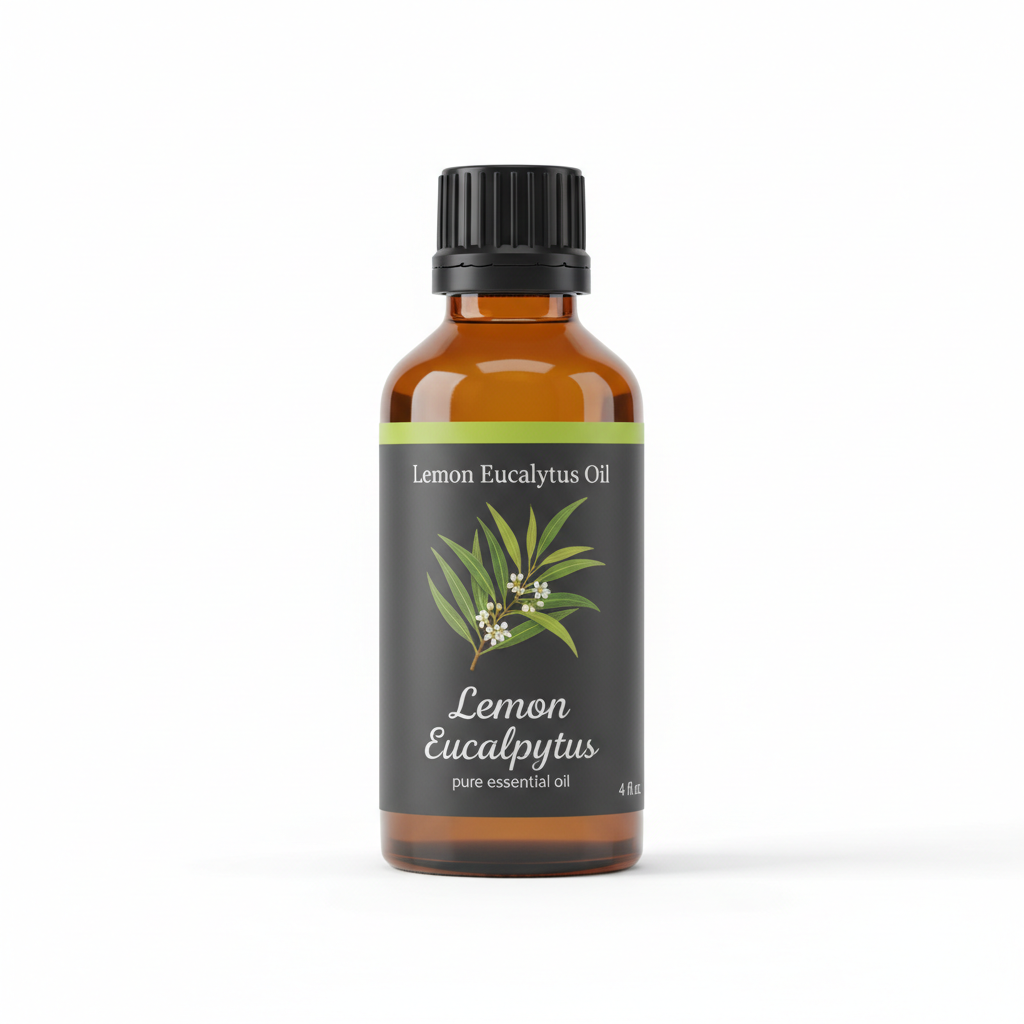
Lemon Eucalyptus Essential Oil
Our own Lemon Eucalyptus Essential Oil, in sizes from 0.5 oz to bulk.
From $9.99
Shop Now →We sell the essential oil, so we should be the ones to say this clearly: a bottle of our oil is the wrong purchase for mosquito protection. It is not a registered repellent and we do not claim it is one. The rest of this page separates the two products that share a name, shows what the evidence behind the registered one looks like, and says where that evidence is thin.
Two products with one name
| Registered OLE or PMD repellent | Lemon eucalyptus essential oil | |
|---|---|---|
| What it is | Refined, PMD-enriched ingredient in a formulated product | Steam-distilled leaf oil, unformulated |
| EPA registered as a repellent | Yes (it has an EPA registration number on the label) | No |
| CDC position | Listed among recommended active ingredients | CDC "does not recommend using 'pure' oil of lemon eucalyptus" as a repellent |
| Has label directions and an age statement | Yes | No repellent directions |
The longer comparison is in OLE vs lemon eucalyptus essential oil, and the broader pillar is Oil of Lemon Eucalyptus: What It Is, How Well It Works.
What the studies show: a plain-English summary box
| Study | Design | What it found |
|---|---|---|
| Barnard and Xue, 2004, J Med Entomol | Lab test of 12 commercial products against three mosquito species | Repel (26% PMD) prevented biting 7.2 hours or more averaged across the three species; repellency index 1.7 against a 7% DEET product |
| Carroll and Loye, 2006, J Am Mosq Control Assoc | Review plus original field and lab data | Authors concluded CDC's 2005 endorsement of PMD was warranted, perhaps an understatement |
| Fradin and Day, 2002, NEJM | 15 volunteers, arm-in-cage, 16 products | 23.8% DEET averaged 301.5 minutes; most botanical products under 20 minutes; soybean-oil product about 95 minutes |
| Maia and Moore, 2011, Malaria Journal | Review of plant-based repellents | PMD gives high protection over several hours; essential oil repellent for about one hour; few studies follow WHO testing guidance |
Sources are linked below. The Barnard and Xue and Carroll and Loye entries are from journal abstracts; the Maia and Moore review was read on PubMed Central.
Why the refined version outperforms the oil
The Maia and Moore review gives a mechanism-level reason. It describes PMD as having a lower vapour pressure than most plant-oil monoterpenes, so it stays on the skin longer, and it reports the essential oil itself as repellent for about an hour in one cited study (Phasomkusolsil and Soonwera, 2010). The review also describes the PMD-rich distillation residue as "far more effective at repelling mosquitoes than the essential oil itself." That is reasoning, not a test of our product: we have never measured our bottle against mosquitoes and do not claim any result.
Two ideas follow from this. First, citronellal, the lemony molecule in the essential oil, is volatile, so a scent that smells strong is not evidence of lasting protection. Second, regulatory status is not paperwork trivia. EPA says registrants of public-health-pest products must show the product meets effectiveness standards (EPA PMD fact sheet). For one 30% OLE spray, EPA reviewed a tick study and accepted data supporting a complete protection time of up to 4 hours (EPA memo, June 2020). Nothing equivalent exists for our oil.
What a registered label claim looks like
Label claims are specific and capped. A 2007 EPA-stamped label for Repel Essential pump spray (EPA Reg. No. 305-57) lists optional marketing claims such as "Repel Essential repels mosquitoes (and deer ticks) for up to six hours", and directions to "reapply once as needed" and "not apply more than twice per day" (EPA label). That is a 2007 document; read the label on any product you buy. We do not sell or endorse that product. EPA also runs a voluntary repellency awareness graphic, and its page says "there are variations in the resulting protection times because of differences in the testing conditions" (EPA). More on duration in how long lemon eucalyptus repellent lasts.
How "protection time" is actually measured
Numbers mean little without the test behind them. Two designs we opened show why. In the 2002 NEJM study, 15 volunteers put a treated, bare forearm into a cage of 10 hungry, disease-free female mosquitoes and the researchers recorded the time to the first confirmed bite (Fradin and Day, abstract). In EPA's 2020 tick study, 25 volunteers per species had a measured typical consumer dose (0.793 microlitres per square centimetre) applied to a forearm, testing began 15 minutes later, and a single tick was placed on the skin every 15 minutes for up to 10 hours. Failure meant one tick crossing 3 cm of treated skin followed by a second crossing within 30 minutes. Both are laboratory designs under controlled conditions, which is why EPA's own page warns that protection times vary with testing conditions.
What this means for a shopper: a lab hour is a best case. A walk through damp grass in July, with sweat and a backpack, will not behave like a forearm in a testing room. We cannot quantify the gap because we have no field data of our own.
Where the evidence is thin
- Species matter. In Barnard and Xue, four of the twelve products gave only about 0.2 hours of protection against Aedes albopictus and Ochlerotatus triseriatus, while all twelve gave at least 2.8 hours against Culex nigripalpus. A single average can hide a weak species.
- Lab versus field. Most reviewed data are arm-in-cage or similar. Maia and Moore say few studies follow WHO guidelines and call for more standardized work.
- Disease outcomes are a different question. A 2014 meta-analysis of topical repellents in malaria-endemic populations found non-significant protection against Plasmodium falciparum (18%) and P. vivax (20%) and concluded repellents are unlikely to be effective alone (Wilson et al., Malaria Journal, 2014). That is not about OLE specifically, but it is why a travel-medicine clinic, not a blog, should decide how to protect a trip.
- Individual variation. In the EPA tick study, individual times for the blacklegged tick ran from 15 to 466 minutes around a 290-minute median.
How we would tell a buyer to decide
Ask three questions, in this order. Do you need protection where a bite carries health risk? Then use the ingredient a travel clinic or CDC's travel pages point to, and see what the studies on OLE and PMD actually show only as background. Is it a garden or porch? Then a registered OLE product is one reasonable option; compare it with others in our ingredient comparison. Do you want a lemony aroma for a candle, diffuser or linen spray? That is what our oil is for, and it is on the shop page.
A decision table, by situation
| Situation | What we would do | Why |
|---|---|---|
| Porch or garden, bites are an annoyance | Consider a registered OLE or PMD product, read the label | CDC lists both ingredients; registered labels state directions and age limits |
| Trip where bites carry health risk | Ask a travel-medicine clinic which ingredient to use | Repellents are one layer; the 2014 meta-analysis above shows limits |
| Child under 3 | Ask a pediatrician before using OLE or PMD | CDC's under-3 guidance, with a label-dependent exception |
| You only have essential oil on hand | Use it for scent, not for bug protection | CDC does not recommend the pure oil as a repellent |
Frequently asked questions
Can I use lemon eucalyptus essential oil as a mosquito repellent?
CDC does not recommend it. It has not been validated for safety and efficacy as a repellent and is not EPA-registered as one. We do not offer dilution or recipe advice for that purpose.
Is oil of lemon eucalyptus safe for children?
CDC says not to use OLE or PMD products on children under 3, with a label-dependent exception for certain OLE-only products at 30% or less. Ask a pediatrician and read the label. See the age guidelines.
Does the lemon smell mean it is working?
No. Scent and protection are separate. A registered label states the protection claim; a pleasant smell does not.
Last reviewed: October 2026. This page summarizes agency and journal statements and is not medical advice. If a repellent is swallowed or gets in eyes, call Poison Help at 1-800-222-1222.
Lemon Eucalyptus Essential Oil
Lemon Eucalyptus Essential Oil from our own shop, in sizes from 0.5 oz to bulk.
From $9.99
Shop Now →Sources & Further Reading
- CDC Yellow Book: Mosquitoes, Ticks, and Other Arthropods
- CDC: Preventing Mosquito Bites
- EPA science review, 30% OLE against three tick species (2020)
- EPA-stamped Repel Essential label (2007)
- EPA: Find the insect repellent that is right for you
- Wilson et al. (2014), Malaria Journal
- Maia and Moore (2011), Malaria Journal
- Barnard and Xue (2004), J Med Entomol
- Carroll and Loye (2006), J Am Mosq Control Assoc
- Fradin and Day (2002), N Engl J Med
- Poison Help