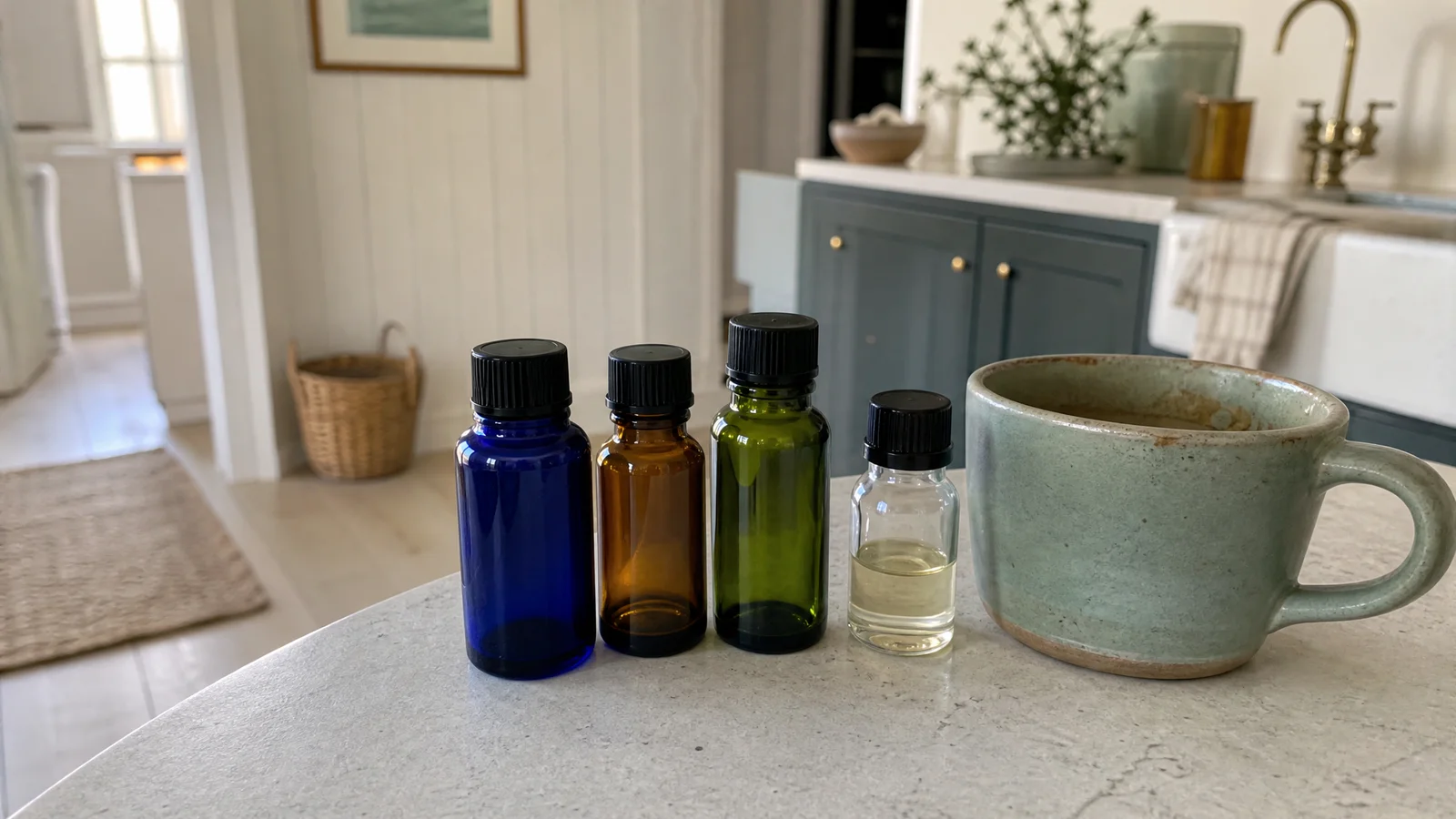
Insect Repellent Ingredients Compared: DEET vs Picaridin vs OLE and More
CDC lists six active ingredients to look for in an EPA-registered repellent: DEET, picaridin, IR3535, oil of lemon eucalyptus (OLE), para-menthane-diol (PMD) and 2-undecanone. In head-to-head studies, DEET and picaridin have the longest protection, OLE/PMD is shorter, and the label on the bottle matters more than the ingredient's reputation.

Lemon Eucalyptus Essential Oil
Our own Lemon Eucalyptus Essential Oil, in sizes from 0.5 oz to bulk.
From $9.99
Shop Now →One disclosure before the comparison: we sell lemon eucalyptus essential oil, which is none of the six. It is not an EPA-registered repellent and we do not sell one. Our stance page says the same. That makes this a comparison written by a seller with nothing riding on which active you choose, and with a clear line between OLE the registered repellent and the oil in our shop (the OLE vs essential oil comparison covers that split in detail).
How we compared them, and what this guide cannot tell you
We ran no tests of our own. Everything below comes from CDC and EPA pages and from published studies we opened, and each figure carries its source. Two limits matter. First, protection times come from different studies with different mosquito species, volunteers, concentrations and methods, so they are good for ranking ingredients and poor for promising a number of hours. Second, a product's own label is the controlling document: EPA states that there are variations in the resulting protection times because of differences in the testing conditions, and tells buyers to use a product with a protection time that fits their activity (EPA, Find the repellent that is right for you).
The master comparison table
This table collects what the cited sources say. Where we could not verify a figure for an ingredient, the cell says so instead of filling the gap.
| Active ingredient | Type (per CDC) | Protection duration, per cited sources | Age notes (CDC) | Worth knowing |
|---|---|---|---|---|
| DEET | Conventional | Longest in comparisons. 23.8% DEET averaged 301.5 minutes in one 2002 lab study; a 2026 review of human studies reports DEET products often last five to nine hours. | No age restriction listed in the CDC Yellow Book; follow the label. | Efficacy tends to peak near 50%. Limited data show DEET applied over sunscreen lowers SPF by about one third. |
| Picaridin | Conventional | A 2026 review reports 8 to 10 hours at 15% to 20% and calls efficacy comparable to DEET in multiple studies. | No age restriction listed in the CDC Yellow Book; follow the label. | The same review calls it less irritating than DEET but relatively expensive. |
| IR3535 | Biopesticide | Mixed. One 2002 product averaged 22.9 minutes; the 2026 review reports 7 to 10 hours at 20% against Culex and Aedes but 3 to 4 hours against Anopheles. | No age restriction listed in the CDC Yellow Book; follow the label. | Duration depends heavily on the product and mosquito species. |
| OLE / PMD | Biopesticide | Shorter than DEET. The 2026 review reports about 4.4 hours at 15% PMD; a 2026 systematic review puts natural-based repellents commonly at two to four hours. | CDC: do not use on children under 3. | Registered OLE is a refined, PMD-enriched material, not the essential oil. |
| 2-undecanone | Biopesticide | We could not verify a head-to-head duration figure. Read the label. | No age restriction listed in the CDC Yellow Book; follow the label. | EPA lists one registered product with this active. |
For scale, EPA's ingredient page lists more than 500 DEET products, about 40 picaridin, about 45 IR3535, 6 PMD, 6 oil of lemon eucalyptus and 1 for 2-undecanone (EPA, skin-applied repellent ingredients). That count is a practical limit on choice, not a ranking: if you want OLE, you are choosing among very few products.
What the studies actually show
The most-cited head-to-head comparison is a 2002 New England Journal of Medicine study by Fradin and Day. Fifteen volunteers tested seven botanical repellents, four DEET products, an IR3535 product, three wristbands and a moisturizer in a controlled laboratory. DEET gave the longest complete protection, the soybean-oil product averaged 94.6 minutes, the IR3535 product 22.9 minutes, every other botanical under 20 minutes, and the wristbands none (Fradin and Day, 2002). The paper is old and the products tested then are not the registered OLE products on shelves now, so read it as the origin of the "DEET lasts longest" consensus and not as a verdict on today's OLE.
A 2015 olfactometer study of eight commercial products on Aedes aegypti and Aedes albopictus found DEET products held repellency longest, PMD products gave comparable results for shorter periods, and some citronella or geraniol products showed no significant repellency (Rodriguez et al., 2015). Carroll and Loye, reviewing PMD in 2006, concluded CDC's endorsement was warranted and argued PMD has DEET-like efficacy against several mosquito genera (Carroll and Loye, 2006). Both findings can be true at once: PMD performs close to DEET in some settings and for a shorter time in others. A 2026 systematic review of 19 human studies reached the same shape: DEET products gave the longest complete protection, essential-oil repellents commonly two to four hours, with microencapsulation improving some formulations (Faridah et al., 2026).
Ingredient by ingredient
DEET: the benchmark
DEET has the longest record and the most products. CDC's Yellow Book notes that its efficacy tends to peak near 50%, so a higher percentage is not automatically better, and that higher concentrations of any active generally last longer but products under 10% active ingredient might offer only limited protection, often 1 to 2 hours (CDC Yellow Book). The same chapter reports limited data that DEET over sunscreen decreases SPF by about one third, which is a reason to reapply sunscreen more often.
Picaridin: the closest rival
The 2026 review in Parasites and Vectors reports picaridin at 15% to 20% lasting 8 to 10 hours and finds multiple studies rating it comparable to DEET (Shi et al., 2026). Our reading: if the reason you are avoiding DEET is feel or gear, picaridin is the ingredient to price-check first. The picaridin comparison goes deeper.
IR3535: read the label, not the ingredient
IR3535 is the ingredient where the studies disagree most, which is a reason to buy by label time and concentration. The 2002 lab result of 22.9 minutes and the 2026 review's 7 to 10 hours at 20% describe different products and species. See the IR3535 comparison.
OLE and PMD: shorter, with an age limit
PMD is a monoterpene recovered from the distillation of lemon-scented gum leaves (Corymbia citriodora), according to Carroll and Loye. CDC's guidance is to not use products containing OLE or PMD on children under 3 years old (CDC, Prevent mosquito bites). One wrinkle: the 2026 Yellow Book text also says products with OLE as the sole active at 30% or less can be used on children under 3, in a different passage from the bullet that says not to. We read the consumer page as the cautious rule and the label as the tie-breaker; ask a pediatrician before using any of these on a young child.
2-undecanone: the newcomer
CDC lists 2-undecanone as a plant-derived active. EPA shows one registered product. We found no head-to-head duration data in sources we could open, so we will not guess; shoppers considering it should rely on the label's own claim.
Where OLE wins, and where it loses
OLE wins when the person using it wants a plant-derived active, will reapply on schedule, and is over 3. It loses on duration against DEET and picaridin in the studies above, on age range, and on choice: very few registered products exist. The Yellow Book also says non-EPA-registered repellents, including some natural ones, have unknown effectiveness and should be avoided. Remember that sentence when a bottle looks natural and carries no EPA registration number.
A quick decision table
| Your situation | Start with | Why |
|---|---|---|
| Long day outdoors, mosquitoes the main concern | DEET or picaridin at label-stated concentrations | Longest protection in the cited comparisons |
| Want to avoid DEET's feel | Picaridin | Comparable efficacy reported; less irritating per the 2026 review |
| Short outing, adult, prefer plant-derived | An EPA-registered OLE/PMD product | Shorter protection, so plan on reapplying per the label |
| Child under 3 | Ask the pediatrician; rely on nets, clothing and timing | CDC says not to use OLE or PMD under 3 |
| Ticks are the concern | A product whose label lists ticks, plus clothing pretreated with permethrin | Skin repellent and clothing work as layers; see lemon eucalyptus vs permethrin |
| Travel to areas with serious mosquito-borne illness | Travel-medicine clinic first | Not a decision for a comparison table; see travel mosquito protection |
Where ingredient comparisons usually go wrong
Most ingredient comparisons rank "natural" and "synthetic" as if the category predicts the result. The studies above do not support that: OLE/PMD sits near DEET in some tests, while botanical products without registration, such as the citronella and geraniol items in the 2015 study, showed no significant repellency. The distinction that predicts performance is whether a product is EPA-registered for the claim it makes. The Yellow Book makes the same point by advising against non-registered repellents. Our ranking of other essential oils follows the same rule.
Where our oil fits in this picture
It does not. Our bottle is a steam-distilled essential oil sold for scent and craft use, and CDC's Yellow Book says it does not recommend using "pure" oil of lemon eucalyptus as a repellent because it has not undergone validated testing for safety and efficacy and is not registered with EPA as an insect repellent. If you want a bug spray, buy one of the registered products above. If you want something that smells like a lemony eucalyptus morning, the shop is the place. For the research that sits behind OLE and PMD, see our research roundup and the pillar guide to oil of lemon eucalyptus.
How to pick one in the store
- Find the EPA registration number on the label, and the active ingredient with its percentage.
- Look for a protection time on the label (EPA allows an optional repellency graphic showing hours for mosquitoes, ticks or both). Choose a time that fits the outing.
- Check the age statement on the label. CDC: not OLE or PMD under 3.
- Use sunscreen first and repellent second, as CDC advises, and follow the label's reapplication rule.
- Look the product up with EPA's repellent search tool if you are unsure what the label means.
FAQ
Is DEET or picaridin better?
The cited studies rate them as comparable, with DEET having the longer evidence record. Choose on feel, gear, price and the label's protection time.
Is OLE as strong as DEET?
Not on duration in the studies we opened. One review reports PMD outperforming 10% DEET within 8 hours but doing slightly worse than 30% DEET; other studies show shorter times.
Can I use a higher percentage to get longer protection?
Only up to a point. CDC's Yellow Book says DEET efficacy tends to peak near 50%. Follow the label and never exceed its directions.
Are "natural" repellents safer?
Natural does not settle safety or efficacy. CDC advises against repellents without EPA registration. For skin, eye or health questions, ask a pharmacist, physician or pediatrician.
Last reviewed: October 2026
Lemon Eucalyptus Essential Oil
Lemon Eucalyptus Essential Oil from our own shop, in sizes from 0.5 oz to bulk.
From $9.99
Shop Now →Sources & Further Reading
- CDC: Prevent mosquito bites (page dated Aug. 28, 2024)
- CDC Yellow Book 2026: Mosquitoes, Ticks, and Other Arthropods
- EPA: Find the insect repellent that is right for you
- EPA: Skin-applied repellent ingredients
- Fradin MS, Day JF. Comparative efficacy of insect repellents against mosquito bites. N Engl J Med, 2002
- Rodriguez SD et al. Efficacy of some commercially available insect repellents for Aedes aegypti and Aedes albopictus. J Insect Sci, 2015
- Carroll SP, Loye J. PMD, a registered botanical mosquito repellent with deet-like efficacy. J Am Mosq Control Assoc, 2006
- Faridah L et al. Effectiveness of mosquito repellents for human: a systematic review. Acta Trop, 2026
- Shi L et al. Integrated strategies for mosquito-borne disease control, with emphasis on repellents. Parasit Vectors, 2026