
Lemon Eucalyptus Research: What the Studies on OLE and PMD Actually Show
The research supports PMD-based repellents, meaning registered oil of lemon eucalyptus (OLE) products, as a reasonable DEET alternative against mosquitoes, usually with shorter or less certain protection than high-strength DEET. It does not support using plain lemon eucalyptus essential oil as a repellent. Almost none of the studies tested the raw oil.
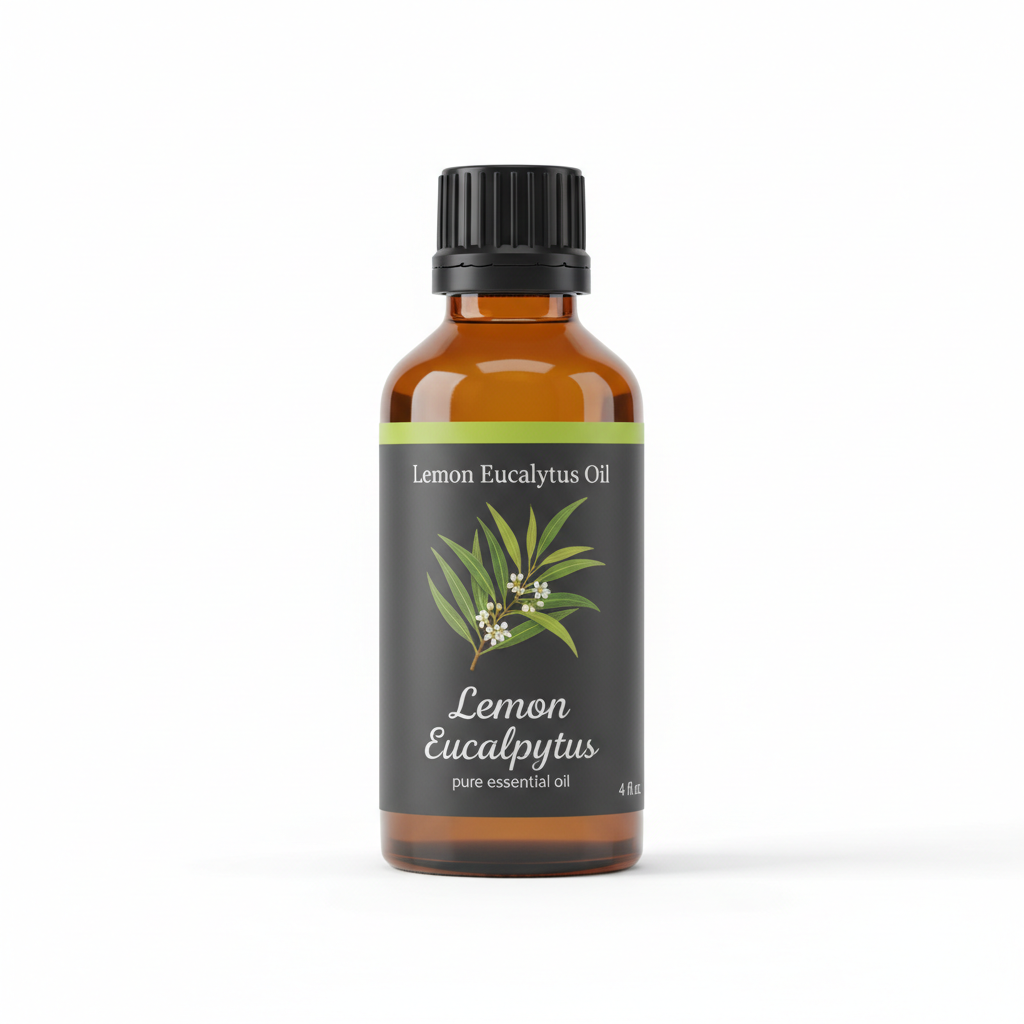
Lemon Eucalyptus Essential Oil
Our own Lemon Eucalyptus Essential Oil, in sizes from 0.5 oz to bulk.
From $9.99
Shop Now →First, separate three things that share one name
"Lemon eucalyptus" in a study can mean three different materials, and the evidence does not transfer between them.
- Lemon eucalyptus essential oil: steam-distilled leaf oil of Corymbia citriodora. This is what we sell. It is not an EPA-registered repellent.
- Oil of lemon eucalyptus (OLE): a refined extract enriched in para-menthane-3,8-diol (PMD). EPA lists it as "contains pmd, but is a separately regulated pesticide chemical" on its skin-applied repellent ingredients page.
- Synthetic PMD: the same molecule made in a factory, regulated separately from OLE.
Carroll and Loye describe PMD as a monoterpene that is a spent product of the distillation of leaves from the Australian lemon-scented gum (Journal of the American Mosquito Control Association, 2006). That is the origin of the confusion: the registered material comes from the tree our oil comes from, but it is a different, processed ingredient. We cover the label differences in OLE vs lemon eucalyptus essential oil and the chemistry in what PMD is.
So when a blog says "studies show lemon eucalyptus repels mosquitoes", the honest follow-up is: which material, which mosquito, which test, and measured how? The rest of this page answers that for the studies we opened.
What "it worked" can mean
Four different measurements sit under the word "works", and they are not interchangeable.
- Time to first bite in a cage, with a treated arm. Fradin and Day used this.
- Attraction in a wind tunnel, counting how many mosquitoes fly toward a human bait. Rodriguez and colleagues used this, and it measures attraction, not bites.
- Bites or landings in the field, the closest to real life and the hardest to run.
- Disease outcomes, such as malaria cases, which are rarer still.
A product can look strong on the second and weak on the first, because evaporation rate matters when the test runs longer. Keep that in mind in the table.
The key studies, summarized
We opened each record below (journal page, PubMed Central or the Europe PMC abstract record). We only report what those records state. Where only the abstract was available, the table says so.
| Study | Design | Result | Limits |
|---|---|---|---|
| Fradin and Day, NEJM 2002 | 15 volunteers, lab; 7 botanical repellents, 4 DEET products, IR3535, 3 wristbands | DEET gave the longest protection; 23.8% DEET averaged 301.5 minutes to first bite; IR3535 product 22.9 minutes; wristbands none | Lab, one set of conditions; a 2002 product line |
| Barnard and Xue, J Med Entomol 2004 | Lab; 4 synthetic and 8 natural repellents, three mosquito species | Several synthetics prevented biting over 7 hours; most natural products about 2 hours or less | Abstract only; product-level results not reviewed |
| Carroll and Loye, JAMCA 2006 | Review plus the authors' own field and lab data on PMD against DEET and others | Authors concluded CDC's 2005 endorsement of PMD was justified and may understate its value | Abstract only (paywalled); authors' own data |
| Maia and Moore, Malaria J 2011 | Review of plant-based repellents | Few studies followed WHO Pesticide Evaluation Scheme guidelines; calls for standardized testing | Abstract only |
| Rodriguez et al., J Insect Sci 2017 | Wind tunnel, Aedes aegypti, human bait at 1 m and 3 m; 11 sprays, 5 wearables, 1 candle | At 1 m: 30% OLE spray 29.62% attracted; 98% DEET 33.70%; 40% DEET 68.55%; 10% picaridin 78.65%; control 88.82% | One species, lab; measures attraction not bites; two published corrections |
| Maia et al., Cochrane 2018 | 10 trials of topical, clothing and spatial repellents against malaria | "There is insufficient evidence to conclude topical or spatial repellents can prevent malaria" | About malaria outcomes, all repellents, not OLE specifically |
| Fatou and Muller, Sci Rep 2024 | Arm-in-cage, 3D infrared tracking; four 20% ethanolic repellents | DEET, PMD, icaridin and EBAAP all substantially reduced bites; mosquitoes still contacted treated skin briefly | Lab, two species; PMD at 20% in ethanol, not a commercial product |
| Nguyen et al., Malaria J 2025 | Odor assays, antennal imaging, volatile measures; synthetic and natural repellents incl. PMD | Natural products did better in rapid odor tests but evaporated faster; slow evaporation helped long-test performance | Abstract only; Anopheles |
What the studies agree on
1. PMD works as a repellent in controlled tests. Rodriguez 2017 found the 30% OLE spray cut attraction from 88.82% to 29.62% at 1 m, close to the 98% DEET product. Fatou and Muller (2024) found PMD at 20% substantially reduced bites. Carroll and Loye reached a similar view in 2006 from field and lab data.
2. Plant products, as a group, wear off faster. Fradin and Day found botanicals other than a soybean product lasted under 20 minutes in 2002 (the soybean product averaged 94.6 minutes). Barnard and Xue found about 2 hours or less for most natural products in 2004. Nguyen et al. (2025) tie the pattern to evaporation. Registered, PMD-enriched OLE sits outside that pattern because it is a refined material, not a raw plant oil.
3. Registration is the best shortcut for a buyer. CDC lists six EPA-registered active ingredients, including OLE and PMD, and says "Do not use products containing OLE or PMD on children under 3 years old." It also warns: "We do not know the effectiveness of non-EPA registered insect repellents, including some natural repellents." (CDC) A related 2024 review in Emerging Infectious Diseases reached the same practical point for ticks: the effectiveness of unregistered botanical products varies considerably. Our answer to whether lemon eucalyptus repels mosquitoes applies these findings to a yes-or-no question.
Where they seem to disagree, and why
Fradin and Day in 2002 concluded that non-DEET repellents could not match DEET for duration. Rodriguez in 2017 found OLE and 98% DEET were about equally effective at 1 m. These can both be right. One measures minutes until the first bite on a treated arm. The other counts how many mosquitoes fly to a person at one moment, 15 minutes into a test. A repellent can drive attraction down strongly early and still fail at hour four. The 3 m result in Rodriguez shows the pattern: the OLE spray's attracted share rose to 51.64% (control 91.25%) while the 98% DEET product stayed at 23.46%.
Also note formulation. The 2002 trial tested products sold then. The 2017 OLE product is described in the paper as a 30% oil of lemon eucalyptus spray. The Cochrane authors, for their part, were not comparing ingredients at all. Their question was disease, and for that outcome the evidence for any topical repellent was too weak to conclude (for example, a risk ratio of 0.65, 95% CI 0.40 to 1.07, for clinical P. falciparum malaria in three studies, rated very low certainty). That is a gap in trial design, not proof that repellents fail, and it is why travelers should ask a clinic rather than a blog.
What the research does not cover
- The essential oil we sell. We found no controlled study in this set that tested plain Corymbia citriodora essential oil as a skin repellent, and we have no test data of our own. Do not infer that our bottle repels anything.
- Ticks. A 2024 paper by Burtis and colleagues tested 11 unregistered botanical-based products on blacklegged tick nymphs: 63% repelled in the first 1.5 hours, falling to 3% between 2.5 and 6.5 hours, while two DEET-based products repelled 97% or more at every point. That tells us about the product category, not OLE specifically.
- Children and pregnancy. The age and pregnancy questions are regulatory and medical, not research gaps this page can fill. Our safety guide sends readers to the CDC and a clinician.
How we suggest you use this research
If you want the benefit the studies describe, buy the registered product, not the raw oil. On the label look for an EPA registration number. EPA also runs a voluntary protection-time graphic that shows the pest and how long a product works; participating companies must give EPA data that it reviews first (EPA). Our ingredient comparison puts OLE next to the other CDC-listed actives. We sell none of these repellents and have no affiliation with any maker.
When you read the next lemon eucalyptus study or headline, ask five things:
- Was the material essential oil, refined OLE or PMD, and at what percentage?
- Which species, and was it in a lab or outdoors?
- Was the result bites, landings, attraction or time to first bite?
- How many people, and was an untreated control included?
- Who funded it, and does the paper have corrections?
FAQ
Is there proof lemon eucalyptus works as well as DEET?
Not as a blanket statement. At 1 m in one wind-tunnel study a 30% OLE spray performed about like a 98% DEET product, but in the 2002 NEJM trial DEET products gave the longest protection. Label protection time is the better guide.
Do the studies prove lemon eucalyptus essential oil repels mosquitoes?
No. The positive results are for PMD-enriched, registered products. CDC also says the effectiveness of non-registered products is unknown.
Why does this page not give a protection time?
Because times differ by study design and by product. Use the time on the label of an EPA-registered product, and see our guide to how long lemon eucalyptus repellent lasts.
Update log: reviewed October 2026. Studies are listed in the order of publication year. Last reviewed: October 2026.
Lemon Eucalyptus Essential Oil
Lemon Eucalyptus Essential Oil from our own shop, in sizes from 0.5 oz to bulk.
From $9.99
Shop Now →Sources & Further Reading
- Fradin MS, Day JF. Comparative efficacy of insect repellents against mosquito bites. N Engl J Med 2002;347(1):13-18
- Barnard DR, Xue RD. J Med Entomol 2004;41(4):726-730
- Carroll SP, Loye J. PMD, a registered botanical mosquito repellent with deet-like efficacy. J Am Mosq Control Assoc 2006;22(3):507-514
- Maia MF, Moore SJ. Plant-based insect repellents. Malar J 2011;10 Suppl 1
- Rodriguez SD et al. J Insect Sci 2017;17(1):24
- Maia MF et al. Mosquito repellents for malaria prevention. Cochrane Database Syst Rev 2018
- Fatou M, Muller P. Sci Rep 2024;14:24745
- Burtis JC et al. Parasit Vectors 2024;17:50
- Eisen L. Emerg Infect Dis 2024;30(1):1-7
- Nguyen MN et al. Malar J 2025
- CDC: Preventing Mosquito Bites
- EPA: Repellency Awareness Graphic
- EPA: Skin-Applied Repellent Ingredients