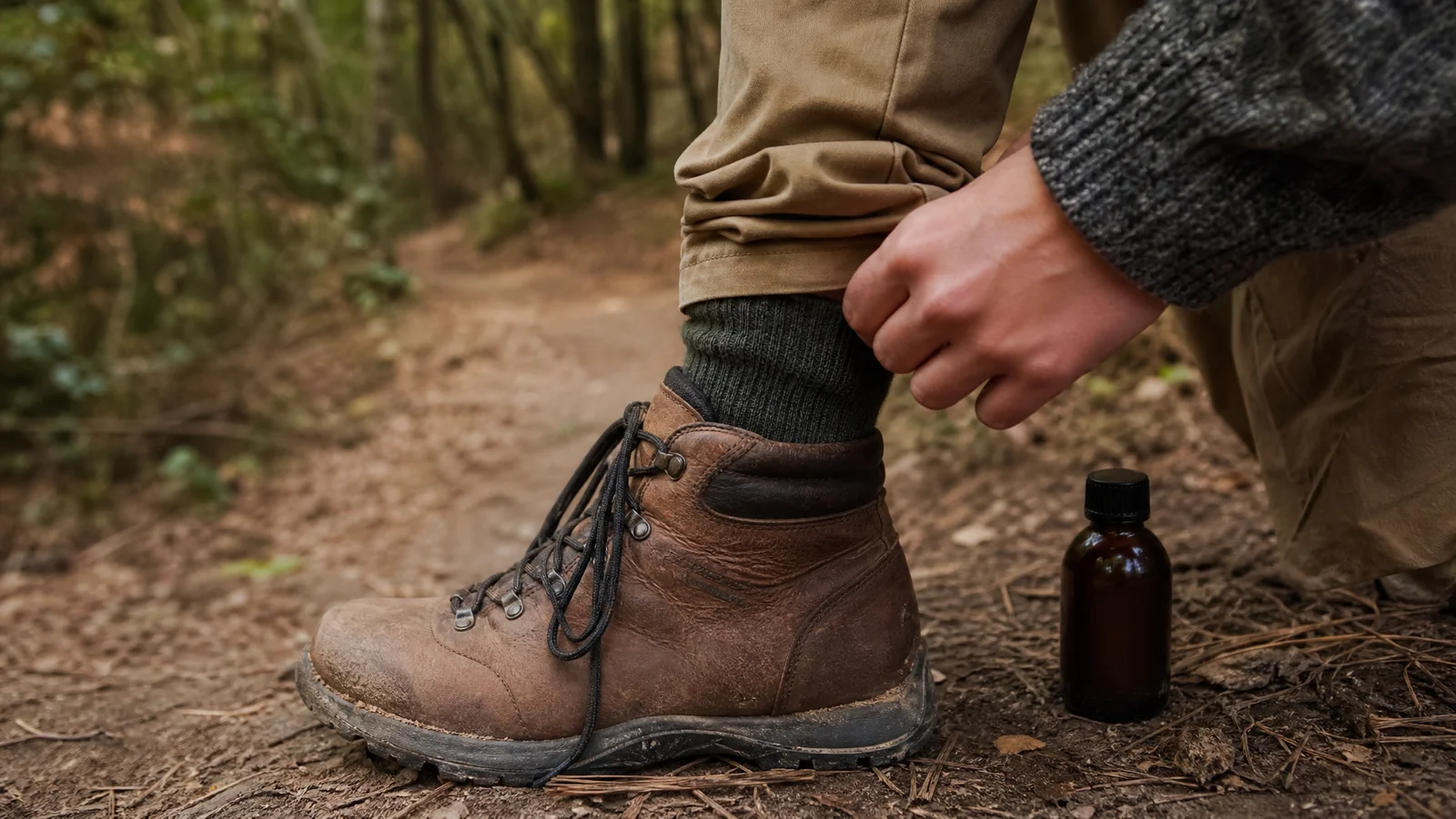
Lemon Eucalyptus vs Permethrin: Skin Plus Clothing Layering
They are not rivals. Permethrin goes on clothing and gear, never on skin, while an EPA-registered repellent such as one containing oil of lemon eucalyptus (OLE) goes on exposed skin. CDC recommends both layers. Permethrin is also a serious hazard to cats until it is dry, which is the risk to plan around.

Lemon Eucalyptus Essential Oil
Our own Lemon Eucalyptus Essential Oil, in sizes from 0.5 oz to bulk.
From $9.99
Shop Now →A disclosure first: we sell lemon eucalyptus essential oil, which is neither a registered repellent nor a permethrin product, and nothing in this article is a recommendation to use our oil for bug protection. The stance page says the same. For the broader comparison of actives, see the ingredient guide.
What each one is
CDC's Yellow Book describes permethrin as an insecticide, acaricide and repellent that, at 0.5% on clothing, is used against ticks, chiggers, mosquitoes and other arthropods, and says it should never be applied to the skin (CDC Yellow Book). A skin repellent, by contrast, is an active ingredient registered for skin: DEET, picaridin, IR3535, OLE, PMD or 2-undecanone (CDC, Prevent mosquito bites). EPA draws the same line: factory-applied clothing protection uses permethrin, and only the skin covered by the factory-impregnated clothing is protected from the listed pests, so exposed skin needs a repellent labeled for human skin (EPA, repellent-treated clothing).
That is the whole answer to the "versus" in the title. A shirt cannot protect your neck, and a skin repellent cannot protect your trouser cuffs for long. The two jobs are different.
The layering table
| Layer | What goes on it | Where it goes | Main caution |
|---|---|---|---|
| Clothing and gear | Permethrin, factory-pretreated or applied at home at 0.5% per CDC | Shirts, trousers, socks, boots, tents, packs | Never on skin. Keep cats away until dry. |
| Exposed skin | EPA-registered repellent (DEET, picaridin, IR3535, OLE/PMD, 2-undecanone) | Hands, neck, face (by hand, not sprayed direct), ankles | Follow the label. OLE and PMD: not for children under 3. |
| Behavior | Tick checks, shower after outdoor time, dry clothes on high heat | Body, gear, pets | No product replaces this |
| Barrier clothing | Long sleeves, long trousers, socks over trouser cuffs | Whole body | Hot weather makes this hard |
How well does permethrin clothing work?
The best evidence we could open is on ticks. A two-year randomized, placebo-controlled, double-blinded trial of 82 outdoor workers in Rhode Island and southern Massachusetts found that factory-impregnated permethrin clothing reduced tick bites by 65% in year one and 50% in year two, a 58% protective effect over the two years, with no adverse outcomes related to the clothing reported (Mitchell et al., 2020). That is a real reduction, and also not complete protection: about four in ten of the bites that would otherwise have occurred still did. The participants were forestry and outdoor workers in uniforms, so the result may not carry over to a hiker in shorts.
A 2022 review by Eisen makes the same point more broadly: experiments show that applying repellents or permethrin to uniform-style clothing can decrease tick bites, but similar studies are lacking for members of the public in summer-weight clothing, and results on tick-borne infection are mixed (Eisen, 2022). In plain terms, permethrin clothing helps, and no one should treat it as a force field.
Laundering and wear: the practical weak point
CDC says permethrin on clothing provides protection after multiple washings, and CDC's Yellow Book says factory-pretreated clothing is labeled for efficacy through many launderings, with home-applied items needing reapplication as the label describes. Read that as a ceiling, not a guarantee. EPA notes that small amounts of permethrin can come off in the wash and instructs consumers to wash permethrin-impregnated clothing separately from other clothing. A 2022 study of forester pants found that after one year of field wear, 33% of participants' pants had no measurable permethrin, and only two sets of clothing still caused 30% or higher tick mortality (Richards et al., 2022). The study used one commercial impregnation on work trousers under hard use, so it is a warning about wear, not a verdict on any brand. If you rely on pretreated clothing, read the hang-tag for the number of washes it is rated for and plan to replace or reapply permethrin accordingly.
The cat problem
This is the section we would not skip. Permethrin is a major cause of poisoning in cats. The American Association of Feline Practitioners notes that cats have insufficient glucuronide conjugation of permethrin in the liver, that dog products typically contain 45% to 60% permethrin while cat-safe products contain under 0.1%, and that signs range from restlessness and drooling to muscle spasms and seizures (AAFP, Permethrin Poisoning and Cats). Cats can be exposed indirectly, for example by grooming a recently dosed dog.
For clothing, two toxicologists interviewed by NPR drew a line between concentrated dog products and household sprays: Dr. Charlotte Means of the ASPCA Animal Poison Control Center said that at 1 percent on clothing, once it dries, it is unlikely you will see problems with the cat, while Dr. Lisa Murphy of the University of Pennsylvania said the key rule is not to put the dog product on the cat (NPR via MPR News, 2018). Both advised keeping the cat away from where you spray, not leaving pretreated clothing where the cat sleeps, changing out of outdoor clothes, and keeping cats from drinking a permethrin soak bucket. If a cat shows tremors, twitching or shaking, that needs an immediate vet visit. The ASPCA Animal Poison Control Center is at (888) 426-4435 and a consultation fee may apply, according to the ASPCA. Questions about your own cat belong with a veterinarian. For other cat and household risks, see lemon eucalyptus and cats.
How to layer, step by step
- Start with clothing and gear: choose factory-pretreated items or apply permethrin as the product's label directs. CDC's Yellow Book advises applying home application 24 to 48 hours before packing so items can dry.
- Put on long sleeves and trousers; tuck trouser cuffs into socks if the label and conditions allow.
- Apply sunscreen first, then an EPA-registered repellent to exposed skin only, per CDC. Do not spray the face directly; spray hands first, then apply.
- Never apply permethrin to skin.
- After outdoor time, check body, clothing, gear and pets for ticks and shower soon after, as CDC advises (CDC, Lyme disease prevention).
Who should skip or modify this
- People with cats in the home: choose factory-pretreated gear, store it away from the cat, and change outside.
- Parents of children under 3: OLE and PMD are off the table per CDC; ask a pediatrician about clothing options.
- Anyone unsure about application: read the permethrin product label and ask a pharmacist.
Where lemon eucalyptus fits
As the skin layer, an EPA-registered OLE or PMD product is one of six options CDC lists. Our essential oil is not that product. CDC's Yellow Book does not recommend "pure" oil of lemon eucalyptus as a repellent because it has not undergone validated testing and is not registered with EPA. For tick-specific questions see the tick guide, the tick prevention checklist and the hiking and camping guide. If you want our oil for what it is good at, a pleasant aroma for craft and home use, see the shop.
Buying decisions: pretreated or do it yourself
CDC lists two routes: buy permethrin-pretreated clothing and gear, or apply a product containing 0.5% permethrin yourself (CDC, Preventing tick bites). Pretreated items have the advantage of a wash rating on the hang-tag; EPA notes the label instructs consumers to follow the hang-tag directions. Home application puts the cat-safety work on you: do it outdoors, keep pets away, and let items dry fully, which CDC's Yellow Book builds into its advice to apply 24 to 48 hours before packing. Neither route changes the basic rule that the wearer still needs a skin repellent on exposed skin and a tick check afterward. For anyone with children, remember that OLE and PMD skin repellents are not for under 3; clothing-based protection and nets matter more there, and a pediatrician should guide the choice.
FAQ
Can I put permethrin on my skin if I am out of repellent?
No. CDC says permethrin should never be applied to the skin. It is for clothing, nets and gear.
Is permethrin clothing enough on its own?
Not by the evidence above: the best field trial found a 58% reduction in tick bites over two years. Use it with a skin repellent and tick checks.
Does permethrin clothing wear out?
Yes. EPA notes small amounts come off in the wash, and one study found a third of work pants had no measurable permethrin after a year. Check the label's wash rating.
Is permethrin safe around pets?
Cats are especially at risk from concentrated products. Dried, low-concentration clothing is lower risk per ASPCA toxicologists, but ask your veterinarian.
Last reviewed: October 2026
Lemon Eucalyptus Essential Oil
Lemon Eucalyptus Essential Oil from our own shop, in sizes from 0.5 oz to bulk.
From $9.99
Shop Now →Sources & Further Reading
- CDC Yellow Book 2026: Mosquitoes, Ticks, and Other Arthropods
- CDC: Prevent mosquito bites
- CDC: Preventing tick bites and Lyme disease (page dated May 21, 2026)
- EPA: Repellent-treated clothing
- Mitchell C et al. J Med Entomol, 2020
- Richards SL et al. J Med Entomol, 2022
- Eisen L. Ticks Tick Borne Dis, 2022
- American Association of Feline Practitioners: Permethrin Poisoning and Cats
- NPR via MPR News: If you spray your clothes with permethrin, be careful around the cat (2018)
- ASPCA Animal Poison Control