What Is PMD Repellent? Para-Menthane-3,8-Diol Explained
PMD (para-menthane-3,8-diol) is a plant-derived repellent ingredient made by converting citronellal, the main molecule in lemon eucalyptus leaf oil. EPA registered it in March 2000 for use on skin and clothing, and CDC lists both PMD and oil of lemon eucalyptus (OLE) among recommended ingredients.
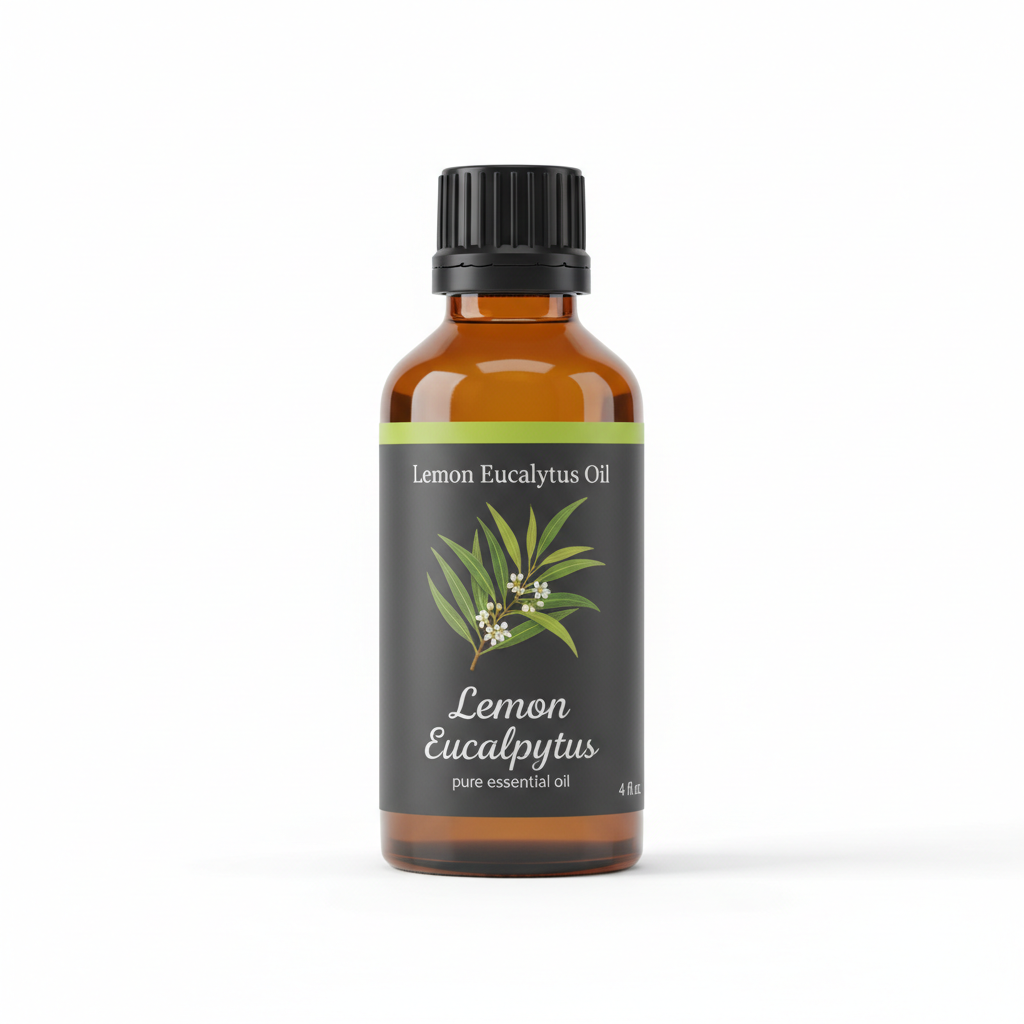
Lemon Eucalyptus Essential Oil
Our own Lemon Eucalyptus Essential Oil, in sizes from 0.5 oz to bulk.
From $9.99
Shop Now →We sell lemon eucalyptus essential oil, which is where the story of PMD begins, so it is worth being exact about where the story ends: our oil contains citronellal but is not PMD and is not a repellent. This page explains the molecule, how it is made from the oil, what regulators say, and one piece of arithmetic that makes repellent labels easier to read.
The molecule in plain terms
PMD has the formula C10H20O2, a molecular weight of 172.26, and the systematic name 2-(2-hydroxypropan-2-yl)-5-methylcyclohexan-1-ol (PubChem record). In plainer language: a six-carbon ring with two alcohol groups. EPA describes it as "structurally similar to menthol" (EPA fact sheet). Citronellal, the oil's main aroma molecule, is an aldehyde, a different chemical family. Our scent explainer, citronellal: the molecule that gives lemon eucalyptus its scent, covers that side.
| Property | Citronellal | PMD |
|---|---|---|
| Where found | Main component of the essential oil (one review cites about 85%) | "Occurs naturally in the lemon eucalyptus plant" (EPA); the refining step exists to raise it |
| Role | Lemony aroma | Active ingredient in registered repellents |
| In our bottle | Yes (the shop describes high natural citronellal) | We make no claim that it is present in a repellent-relevant amount |
How PMD is made from the leaf oil
Two sources, with different kinds of authority. EPA says the natural oil can be extracted from leaves and twigs, while "for commercial use, the active ingredient is chemically synthesized." The supplier Citrefine says it steam distills the oil from leaves and twigs and then runs "a simple process converting high levels of citronellal in the oil into more PMD" (Citrefine, a company page, so a manufacturer's own description).
The chemistry underneath is known in the literature as a cyclization of citronellal, often called a Prins reaction. A 2026 laboratory paper reported that ultrasound-assisted synthesis gave 98% PMD purity in 2 hours, versus 87% after 10 hours with conventional heating, and that reaction time with lemon eucalyptus oil fell from 15 hours to between 0.5 and 2 hours (Phan et al., Ultrasonics Sonochemistry, 2026, abstract). The same abstract notes cis and trans forms of PMD, and that crystallizing PMD from lemon eucalyptus oil raised the cis-isomer content to 90%. That is a lab-scale study and not a description of any seller's product, but it shows why this is a processing step, not something that happens in a bottle on a shelf.
Reasoned from the documented facts: because making PMD needs a controlled reaction, an essential oil that has been sitting on a shelf does not become a repellent. Citronellal in the oil can oxidize with age, which is a different change; see how to store lemon eucalyptus oil and keep the citronellal.
PMD versus OLE: the arithmetic on the label
EPA lists oil of lemon eucalyptus and PMD as separate active ingredients and says OLE "contains pmd, but is a separately regulated pesticide chemical" (EPA). On a real 2007 label for Repel Essential (EPA Reg. No. 305-57), the active ingredient is OLE with a footnote: "Approx. 65% p-menthane-3,8-diol" (EPA label). From that, a simple rule of thumb follows, which is our arithmetic, not an official statement: multiply the OLE percentage by about 0.65 to estimate PMD. A "30% OLE" product comes to roughly 19.5% PMD.
| Label says | Rough PMD content (at the label's approx. 65%) |
|---|---|
| 20% OLE | about 13% |
| 30% OLE | about 19.5% |
| 40% OLE | about 26% |
That is why "30% lemon eucalyptus" and "30% PMD" are not the same claim. Always read which ingredient the percentage belongs to; what 30% means goes further. Your own label may state a different PMD share, so treat the table as an illustration.
What regulators and researchers say
- EPA registration. PMD was registered in March 2000 as a biochemical pesticide for products applied to skin and clothing. EPA states the target pests include mosquitoes, biting flies and gnats, that animal studies showed no adverse effect except eye irritation, and that label precautions include "Do not get in eyes. Do not apply on face or hands of small children." If used as directed, EPA said it is not expected to pose health risks (EPA, 2000). That is a 2000 document.
- CDC. Lists PMD and OLE as active ingredients in EPA-registered repellents, and says parents should not use OLE or PMD products on children under 3, with an exception for certain OLE-only products at 30% or less, so read the label (CDC Yellow Book, April 2025).
- Efficacy. In a 2004 laboratory comparison, Repel (26% PMD) prevented biting for 7.2 hours or more averaged across three mosquito species (Barnard and Xue, abstract). A 2006 review concluded the CDC's endorsement was warranted (Carroll and Loye). The Maia and Moore review attributes PMD's longer protection to a lower vapour pressure than most plant monoterpenes (Malaria Journal, 2011).
- How it works. Mechanism research is still active. One 2014 study found that DEET, picaridin, IR3535 and PMD all activated the odorant receptor CquiOR136 in Culex quinquefasciatus mosquitoes (Xu et al., PNAS, 2014, abstract). Receptor activation in a lab does not by itself tell you a product's protection time.
Where PMD came from
PMD has a short documented history. Maia and Moore's review says lemon eucalyptus was identified in the 1960s through mass screening of plants used in Chinese traditional medicine (Malaria Journal, 2011). The Carroll and Loye abstract describes PMD as a monoterpene by-product of distilling the leaves of the Australian lemon-scented gum, and says CDC endorsed it in April 2005 (J Am Mosq Control Assoc, 2006). EPA's registration came earlier, in March 2000. The tree itself is covered in Corymbia citriodora: the lemon-scented gum behind the oil.
How to use this when shopping
- Find the active-ingredient panel and note whether the percentage belongs to "oil of lemon eucalyptus" or "PMD".
- If it says OLE, multiply by roughly 0.65 for a ballpark PMD figure, and treat that as an estimate.
- Compare products on the same ingredient basis, not on the front-of-pack number alone.
- Check the EPA registration number and the age statement.
The buying side is covered in how to choose a lemon eucalyptus repellent.
Three common misreadings
- "PMD is a pesticide, so it must be dangerous." Pesticide is the legal category for anything marketed to repel pests. EPA's 2000 fact sheet said it was not expected to pose health risks when used as labeled. That is a regulator's statement from 2000, not a guarantee for every person, so patch caution and the label still apply.
- "Plant-derived means it is the same as the plant oil." The processing step changes the chemistry, which is the whole point of this page.
- "A higher percentage is always better." CDC notes concentration affects duration, but the label's percentage and directions are what was tested.
What PMD does not mean for our oil
Three honest limits. First, we make no PMD measurement: we have no GC/MS report to cite here, and we do not claim any PMD level in our bottle. Second, PMD in a registered spray comes with testing, a label and an age statement; essential oil does not. Third, the refining step exists to raise PMD, which implies the raw essential oil carries much less of it. If your goal is bug protection, a registered product is the answer. See OLE vs lemon eucalyptus essential oil and the pillar Oil of Lemon Eucalyptus. For a scented oil for candles and diffusers, see our shop page.
Frequently asked questions
Is PMD the same as OLE?
No. OLE is the refined oil that contains PMD. EPA registers them as separate ingredients.
Is PMD natural?
PMD occurs naturally at low levels in the plant, but EPA says commercial PMD is chemically synthesized. CDC calls OLE a plant-derived ingredient.
Is PMD safe for children?
The EPA fact sheet says it is not expected to pose health risks when used per the label. CDC says not under age 3, with a label-dependent exception. Ask a pediatrician. See the safety guide.
Does lemon eucalyptus essential oil contain PMD?
EPA says PMD occurs naturally in the plant; a review reports the oil is mostly citronellal. We cannot state a PMD figure for our oil.
Last reviewed: October 2026. This page reports regulator and journal statements and is not medical advice. If a repellent is swallowed or gets in the eyes, call Poison Help at 1-800-222-1222.
Lemon Eucalyptus Essential Oil
Lemon Eucalyptus Essential Oil from our own shop, in sizes from 0.5 oz to bulk.
From $9.99
Shop Now →Sources & Further Reading
- EPA: p-Menthane-3,8-diol fact sheet (2000)
- EPA: Skin-applied repellent ingredients
- EPA-stamped Repel Essential label (2007)
- CDC Yellow Book (April 2025)
- PubChem: p-menthane-3,8-diol
- Phan et al. (2026), Ultrasonics Sonochemistry
- Xu et al. (2014), PNAS
- Maia and Moore (2011), Malaria Journal
- Citrefine (manufacturer page)
- Poison Help