Lemon Eucalyptus Repellent Concentration: What 30% Means
On a registered lemon eucalyptus repellent, "30%" is the oil of lemon eucalyptus (OLE) content, and the labels we read footnote OLE as approximately 65% PMD. That works out to roughly 19.5% PMD, the figure that does the work. A 30% OLE product is the common benchmark; below about 10% active ingredient, CDC warns protection may be limited.
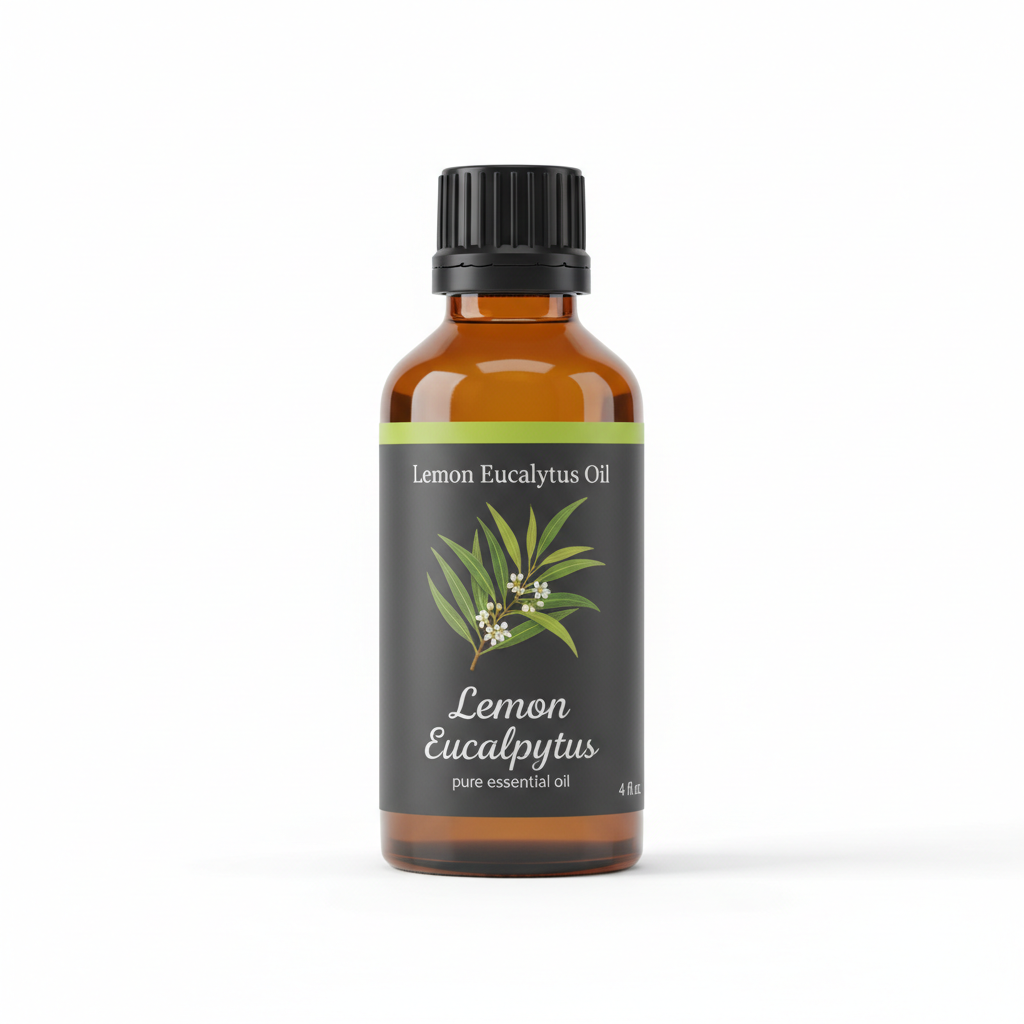
Lemon Eucalyptus Essential Oil
Our own Lemon Eucalyptus Essential Oil, in sizes from 0.5 oz to bulk.
From $9.99
Shop Now →Last reviewed: October 2026
A note on scope
This page is about registered repellents made by other companies. We sell Lemon Eucalyptus Essential Oil, which is not a registered repellent, and the percentages below do not describe it. A bottle of our oil (see the shop for aromatic and craft use) is 100% pure essential oil; there is no repellent "strength" to read off it. For the PMD chemistry in plain terms, see what PMD is and how it is made, and for the whole topic see our OLE guide.
OLE percentage versus PMD percentage
Oil of lemon eucalyptus as used in repellents is not the raw steam-distilled oil. Penn State Extension describes it as a synthetic concentration of para-menthane-3,8-diol (PMD), synthesized from lemon-scented gum tree plant oil. EPA's ingredient page says OLE "contains PMD, but is a separately regulated pesticide chemical," and lists PMD as its own ingredient too.
So a label can state one of two numbers. When it states OLE, find the footnote. The Repel labels we opened say "Approx. 65% p-menthane-3,8-diol." Multiply them and you get the PMD content:
30% OLE x 0.65 = 19.5% PMD (our arithmetic, not a printed figure).
This matters because the University of Wisconsin mosquito site reports that 20% PMD provided protection equal to 20% DEET, while a 10% formulation was not as effective. A 30% OLE product lands almost exactly on that 20% PMD mark. That is a good reason the number 30 keeps appearing: it is not arbitrary. We are reasoning from those published figures, and we have not tested this ourselves.
Concentration table from labels we actually opened
| Product and source | Label OLE | PMD footnote | PMD we calculate | Pest and time claim on the document |
|---|---|---|---|---|
| Repel Plant-Based Lemon Eucalyptus, EPA Reg. No. 305-62 (2012 label, retailer-hosted) | 30.0% | Approx. 65% | About 19.5% | Mosquitoes, "up to 6 hours" |
| Repel Essential lotion, EPA Reg. No. 305-56 (2003 master label) | 30.0% | Approx. 65% | About 19.5% | Optional claims include mosquitoes and deer ticks "for up to six hours" |
| Repel Essential pump spray, EPA Reg. No. 305-57 (2007 label record) | 60.0% (as extracted from the PDF) | Approx. 65% | About 39% | Not confirmed; the scan text was incomplete |
| Murphy's Naturals Lemon Eucalyptus spray (manufacturer page, October 2026) | 30% | Not stated on the page | Not calculable | Mosquitoes up to 6 hours; deer ticks up to 4 hours; lone star and brown dog ticks over 8 hours |
Two cautions. The 60% figure comes from text extracted from an EPA scan, and the same company's later 2012 label lists 30%, so do not buy anything based on the old number. The Murphy's tick times are statements on the manufacturer's own page; we have not seen the registered label behind them. This is a short list because we only include what we opened. Our shortlist method shows how to build a longer one from EPA's search tool.
What strength buys you: duration, with sources that disagree
CDC's Yellow Book states that higher concentrations of active ingredient provide longer duration of protection and that products with under 10% active ingredient may offer only limited protection, often 1 to 2 hours. For OLE specifically, the published ranges differ:
- Penn State Extension lists OLE at a recommended 30% with a duration of 2 to 5 hours.
- The University of Wisconsin mosquito site says lemon eucalyptus products provide the longest protection (6 to 8 hours) among plant-derived repellents.
- The labels we read say "up to 6 hours" for mosquitoes.
We would not average these. Penn State and Wisconsin appear to be summarizing different studies, and a label's number is the manufacturer's claim at the time of registration. EPA's repellency awareness graphic page says the protection time shown is a "typical" figure drawn from multiple studies, and that actual protection may vary. Use the low end for planning and the label as the ceiling. See how long lemon eucalyptus repellent lasts.
More is not automatically better
Do not read 60% as "twice as strong" as 30%. We found no source we opened that shows OLE protection increasing indefinitely with percentage. For DEET, CDC says efficacy tends to peak at roughly 50%, with higher concentrations not markedly extending protection against mosquitoes. We are not saying OLE behaves the same way; we are saying the claim "more is better" needs evidence that we did not find.
What does change with a higher number is the label's reapplication ceiling. The labels we read say to reapply once as needed and not to apply more than twice per day. Whatever the percentage, those caps are the rule on that product.
How the other actives compare on concentration
Penn State Extension's table gives context for the 30% figure, all for EPA-registered products:
| Active ingredient | Recommended concentration | Duration listed | Child age listed |
|---|---|---|---|
| DEET | 25% to 40% | 2 to 8 hours | 2 months and older |
| Picaridin | 10% to 20% | 3 to 10 hours | 2 months and older |
| IR3535 | 20% | 4 to 6 hours | 2 months and older |
| Oil of lemon eucalyptus | 30% | 2 to 5 hours | 3 years and older |
| 2-undecanone | 7.75% | 2 to 4 hours | Consult label |
Percentages are not comparable across active ingredients: 20% picaridin and 30% OLE are different molecules at different doses. Compare protection time and age rules, not the bare number. The full side-by-side is in our ingredients comparison.
Matching strength to the outing
This is our reasoning, drawn from the sources above and not from a test:
- Under about two hours outdoors: a lower strength may be enough, per the University of Wisconsin page, which says 5 to 10% may be fine for exposures of 1 to 3 hours. Keep CDC's under-10% caveat in mind.
- Half a day: a 30% OLE product, planning on the low end of the duration range, with the label's reapplication limit in mind.
- Full day, hot weather, heavy sweating: a single application may not carry you. If you run into the label's twice-per-day cap, consider a different active ingredient; our sweat and swimming piece has the details.
- Disease-risk travel: ask a travel-medicine clinic. We will not rank repellents for malaria or dengue areas.
Why the 0.5% to 2% on our shop page is a different thing
Our shop page advises that for topical use of the essential oil, you dilute 0.5% to 2% in a carrier oil and patch test first. That figure is a skin-comfort guideline for an aromatic oil. It is not a repellent strength, and it does not turn a carrier-oil blend into something comparable with a 30% OLE product. A diluted essential oil has not been tested the way a registered product has. If you want dilution arithmetic for fragrance, see how to dilute lemon eucalyptus oil.
Who should not choose a high-strength OLE product
CDC says not to use OLE or PMD products on children under 3. One manufacturer says EPA has dropped the age restriction for 30% OLE products, and CDC's Yellow Book mentions certain OLE-only products at 30% or below may be used under 3 if the label allows. We cannot settle that for you; the label and a pediatrician can. During pregnancy or breastfeeding, ask your OB-GYN or midwife. For skin reactions, see our skin irritation guide.
FAQ
Is 30% OLE the same as 30% PMD?
No. On the labels we read, OLE is approximately 65% PMD, so 30% OLE is about 19.5% PMD by simple multiplication. Some products list PMD directly, so read the active ingredient box.
Is a higher percentage safer or stronger?
We found no source saying higher OLE percentages are safer. They may carry stricter labels. Follow the printed limits.
What is the best concentration for kids?
We do not give child-dosing advice. Follow the label and ask a pediatrician. CDC says not to use OLE or PMD on children under 3.
Can I reach 30% by mixing our essential oil with a carrier?
We do not recommend it and give no recipe. A mixed oil is not a registered repellent, and a 30% dilution of an essential oil on skin is far above the 0.5% to 2% our shop page advises for topical use.
Who should I ask?
A pharmacist or physician for general questions, a pediatrician for children, an OB-GYN or midwife in pregnancy. For swallowing or eye contact, call Poison Help at 1-800-222-1222.
Lemon Eucalyptus Essential Oil
Lemon Eucalyptus Essential Oil from our own shop, in sizes from 0.5 oz to bulk.
From $9.99
Shop Now →Sources & Further Reading
- CDC Yellow Book: Mosquitoes, Ticks, and Other Arthropods
- Penn State Extension: Tick and Mosquito Repellent Guide
- University of Wisconsin: Repellents for application to skin
- EPA: Skin-applied repellent ingredients
- EPA: Repellency Awareness Graphic
- Repel Plant-Based Lemon Eucalyptus label, EPA Reg. No. 305-62 (2012 version, retailer-hosted)
- EPA label record: Repel Essential lotion master label, 305-56 (2003)
- EPA label record: Repel Essential pump spray, 305-57 (2007)
- Murphy's Naturals product page (manufacturer statements)