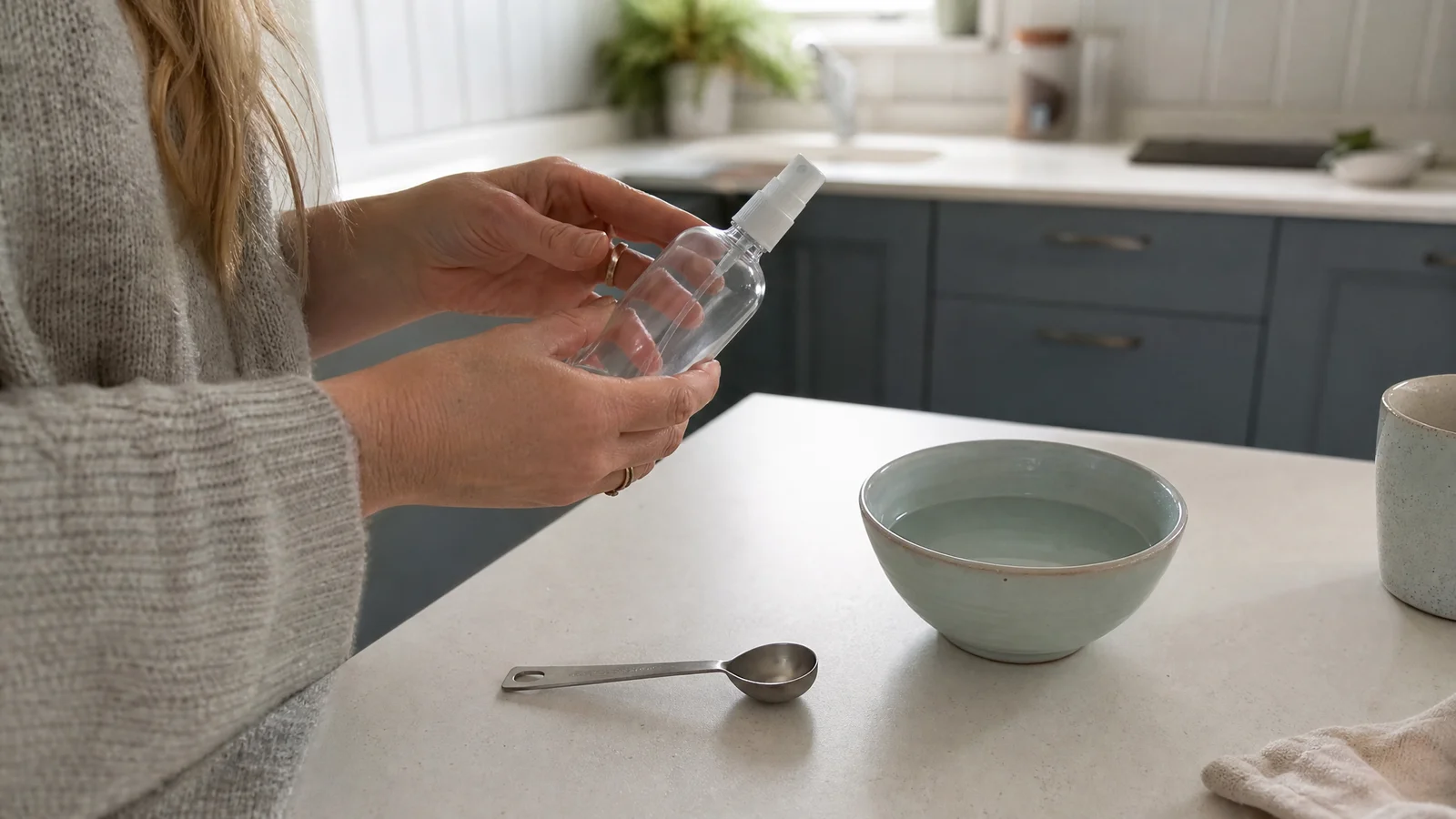
DIY Lemon Eucalyptus Bug Spray: Why It's Not the Same as OLE Repellent
A homemade spray made with lemon eucalyptus essential oil is not an OLE repellent. CDC does not recommend "pure" oil of lemon eucalyptus as a repellent: it has not undergone validated testing for safety and efficacy and is not registered with EPA. We sell that essential oil, and we do not recommend it for this.

Lemon Eucalyptus Essential Oil
Our own Lemon Eucalyptus Essential Oil, in sizes from 0.5 oz to bulk.
From $9.99
Shop Now →That is an unusual thing for an oil shop to write, so here is the reasoning. Search results for "DIY lemon eucalyptus bug spray" are full of recipes that handle the essential oil and the registered repellent ingredient as one material. They are not, and the gap between them is the whole subject of this page. We will not give a recipe or any measurements, and below we explain why that is a deliberate choice and not an oversight. Last reviewed: October 2026.
What an "OLE repellent" actually is
CDC's mosquito-bite guidance tells people to use EPA-registered insect repellents with one of a short list of active ingredients: DEET, picaridin, IR3535, oil of lemon eucalyptus (OLE) or para-menthane-diol (PMD), and 2-undecanone. The operative word is registered. EPA says the registration number on a label "means the company provided EPA with technical information on the effectiveness of the product" (EPA, Using Insect Repellents Safely and Effectively).
So an OLE repellent is a finished, formulated product that a company submitted to EPA, with a fixed active-ingredient percentage, label directions and an age restriction. CDC's age line is specific: do not use products containing OLE or PMD on children under 3 years old. A bottle of essential oil in your cabinet has none of that attached to it. If you want the longer explanation of how the refined registered material differs from the steam-distilled oil, read our comparison of OLE and lemon eucalyptus essential oil, or start at the hub guide to oil of lemon eucalyptus.
What CDC and EPA say about the pure oil
CDC addresses this directly in its Yellow Book chapter on mosquitoes, ticks and other arthropods. It does not recommend "pure" oil of lemon eucalyptus because "it has not undergone validated testing for safety and efficacy and is not registered with EPA as an insect repellent." The same chapter says that "the effectiveness of non-EPA-registered insect repellents, including some natural repellents, is unknown."
EPA's page on skin-applied repellents adds context. Some repellents are sold without registration because EPA determined in the 1990s that certain ingredients (it names citronella oil, cedar oil, geranium oil, peppermint oil and soybean oil) posed minimal risk to human health. EPA is explicit that "products made from these ingredients have not been evaluated for effectiveness," and that for products without a registration number "EPA cannot advise consumers about the effectiveness of these products." Notice what that means for a kitchen-table mix: even where the safety side has been reviewed, nobody has verified the performance side.
Why a homemade spray cannot borrow a registered product's evidence
When a study shows that an OLE product works, the result belongs to that product. In a 2017 wind-tunnel comparison published in the Journal of Insect Science, a commercial lemon eucalyptus spray significantly reduced the attraction of Aedes aegypti mosquitoes to a volunteer, as did DEET products, while several bracelets and a citronella candle did not (Rodriguez et al., 2017). That is evidence for one registered, formulated product at its labeled strength. It says nothing about a mixture a person assembles at home, because three things that decide the outcome are unknown in a DIY spray:
- The amount of active material that reaches the skin. Homemade mixes separate, settle and spray unevenly. A label states a percentage; a hand-shaken bottle does not.
- How long it lasts. A review of plant-based repellents in Malaria Journal notes that essential-oil ingredients "tend to be highly volatile," which "contributes to their poor longevity as mosquito repellents" (Maia and Moore, 2011). Registered products carry a tested protection claim; a DIY mix carries nothing, so a person cannot know when it has stopped working.
- Which pests it covers. Even among essential oils that have been tested head to head, results differ by oil and by pest. In a 2023 Scientific Reports study of 20 essential oils applied as 10% lotions, citronella protected against mosquitoes for about 30 minutes and did not significantly protect against ticks, while clove and cinnamon gave more than an hour against both (Luker et al., 2023). Lemon eucalyptus essential oil was not among the 20, so that evidence set contains no result for it at all.
A CDC-authored 2024 perspective on unregulated "minimum risk" products reached the same practical conclusion: effectiveness differs among these products, and recommendations cannot reliably be made from the active ingredient alone (Eisen, 2024). Our reading is that a homemade spray is the least documented version of an already undocumented category.
The safety problems with homemade sprays
Efficacy is only half of it. The other half is that "natural" and "tested for skin" are different claims. The Malaria Journal review says plainly that "it cannot be assumed that natural equates to safe," and that essential oils can be irritating to skin, with many causing contact dermatitis. Poison Control's essential oils guidance says misuse of essential oils can cause serious poisoning, that children have thin skin and immature livers, and that diluting in a carrier oil is the best way to avoid a bad reaction from direct skin contact. It also advises against use on damaged skin and says the oils must be locked up, out of sight and reach of children and pets.
Our own bottle's guidance points the same way: keep it away from eyes, children and pets, and do not take it internally. Spraying a mist onto skin and around the face puts an oil near the eyes and mouth of whoever is nearby, which is a different exposure from a measured drop in a diffuser. If anyone swallows an essential oil or a product containing one, or gets it in the eyes, call Poison Help at 1-800-222-1222 (the number listed on poison.org) or use the online tool there. For a child, a rash, or anything involving breathing, contact a physician or emergency services.
There is also the false-confidence problem. Someone who sprays a homemade mix and then walks into tall grass in tick country, or a region with mosquito-borne illness, believes they have a layer of protection that nobody has measured. CDC's advice for those situations is the registered-product advice above. Anyone planning travel should ask a travel-medicine clinic, and anyone with questions about a specific illness should ask a physician.
Table: DIY spray versus registered OLE repellent
| Question | Registered OLE repellent | Homemade spray with the essential oil |
|---|---|---|
| Evaluated by EPA | Yes. Label carries an EPA registration number | No |
| CDC recommendation | Listed among recommended active ingredients | CDC does not recommend "pure" oil of lemon eucalyptus as a repellent |
| Stated strength | Active-ingredient percentage on the label | Whatever the person mixed; unverifiable |
| Protection time | Product-specific, from label and registration data | Unknown |
| Age guidance | CDC: not for children under 3 | None exists; no testing in children |
| Who answers for it | The registrant, under federal pesticide law | Nobody |
What to do instead
- Buy a registered product. EPA's repellent search tool lets you filter by target pest, protection time and active ingredient. Choose the pest you are worried about first (mosquitoes and ticks are not always on the same label), then the protection time you need.
- Read the label for the age line. If a child under 3 is involved, CDC says not to use OLE or PMD products; ask the child's pediatrician which option fits.
- Use the non-spray layers. Long sleeves, trousers, screens and netting work without being applied to anyone's skin.
- Do not stack your own additions. EPA labels state that it is a violation of federal law to use the product inconsistently with its labeling (we read that line on an EPA-accepted IR3535 label). Mixing essential oil into a registered product puts you outside its directions.
For a ranked look at how other essential oils compare on the evidence, see our essential-oil evidence ranking, and for the safety picture of the registered product, the lemon eucalyptus safety guide.
Where the essential oil does belong
Our Lemon Eucalyptus Essential Oil is a fragrance and craft material: a lemony, fresh, green top note that we say blends with lemongrass, lavender, cedarwood, peppermint and sweet orange. People buy it for candles, soap, diffusers and room or linen sprays, and the live room and linen spray project is a good example of a use we are comfortable with because it asks the oil to smell good and nothing more. For skin-contact fragrance uses, read the dilution guide first. You can see the sizes on our shop page, and our stance page repeats that this is not a registered repellent.
FAQ
Can I add lemon eucalyptus oil to my store-bought repellent?
We advise against it. A registered repellent is tested as formulated, and its label limits how it may be used. Adding something changes the product into one nobody has tested, and the label directions no longer describe what you are applying.
Is a DIY spray at least safer because it is natural?
Not necessarily. The Malaria Journal review cautions that natural does not equal safe, and Poison Control notes that essential oils can irritate skin and, if misused, cause serious poisoning. Registered repellents also come with label precautions, which a homemade mix lacks.
Does a DIY spray work at all?
Nobody can say, and that is the problem. Studies exist on some essential oils in lab settings, with varied results, but none we found tested a homemade lemon eucalyptus essential oil spray. Individual experience is also unreliable because mosquito attraction varies from person to person and day to day.
What about my child?
Do not put a homemade essential-oil mixture on a child. For a registered product, follow the label and CDC's rule that OLE and PMD products are not for children under 3, and ask your pediatrician about alternatives and non-spray measures.
Is this the same as the myths on your other page?
It is closely related. The myths article covers the wider set of misunderstandings about this oil; this one focuses on the bug-spray recipe.
Lemon Eucalyptus Essential Oil
Lemon Eucalyptus Essential Oil from our own shop, in sizes from 0.5 oz to bulk.
From $9.99
Shop Now →Sources & Further Reading
- CDC: Preventing mosquito bites (EPA-registered repellents and active ingredients)
- CDC Yellow Book: Mosquitoes, Ticks, and Other Arthropods
- EPA: Using Insect Repellents Safely and Effectively
- EPA: Regulation of Skin-Applied Repellents
- EPA: Find the repellent that is right for you
- Rodriguez et al. (2017), Journal of Insect Science
- Maia and Moore (2011), Malaria Journal
- Luker et al. (2023), Scientific Reports
- Eisen (2024), Emerging Infectious Diseases
- Poison Control: Essential oils
- EPA-accepted label, Bug Repell IR3535 20% Aerosol (EPA Reg. No. 70759-4)