How to Dilute Lemon Eucalyptus Oil: Dilution Chart and Carrier Oils
For skin, our shop's guidance is to dilute lemon eucalyptus essential oil to 0.5% to 2% in a carrier oil and patch test first. That works out to roughly 3 to 18 drops per fluid ounce (30 mL) of carrier, depending on drop size. Dilution makes the oil gentler to wear. It does not make it an insect repellent.

Lemon Eucalyptus Essential Oil
Our own Lemon Eucalyptus Essential Oil, in sizes from 0.5 oz to bulk.
From $9.99
Shop Now →What dilution does, and what it does not do
Dilution lowers the share of the bottle that is concentrated essential oil. It is a comfort and safety step for fragrance on skin, nothing more. A diluted blend is still a cosmetic-style scent product: we make no claim that it protects against bites, ticks or disease, and we do not suggest you use it that way.
That last point matters because lemon eucalyptus is one of the few plants with a famous repellent connection, and the connection is easy to misread. CDC states that it does not recommend using "pure" oil of lemon eucalyptus (an essential oil that is not formulated) as a repellent, because it has not undergone validated testing for safety and efficacy and is not registered with EPA as an insect repellent. The registered repellents are different, refined products sold by other companies. We sell none of them. Our comparison of OLE and the essential oil explains the split, and our stance page says the same thing.
So the question this page answers is narrower: how much of our oil goes into how much carrier when you want a scented body oil, roll-on or similar leave-on blend. For what the oil is genuinely good for, see our guide to lemon eucalyptus essential oil uses.
Step one: choose a percentage, and start low
Percentages are weight-or-volume shares of the finished blend. A 1% blend is 1 part oil to 99 parts carrier. The ranges below come from two different places, and they are worth keeping separate.
| Use | Range | Where it comes from |
|---|---|---|
| Our shop's guidance for topical use of this oil | 0.5% to 2% | Lemon Eucalyptus Essential Oil page on our shop |
| Reactive or sensitive skin | 0.2% to 1% | Tisserand Institute, general guideline for all essential oils |
| Face and other sensitive areas such as underarms | 0.5% to 1.2% | Tisserand Institute, general guideline for all essential oils |
| Body oils and lotions | 1% to 3% | Tisserand Institute, general guideline for all essential oils |
The Tisserand Institute dilution ranges are generic. They are written for essential oils as a class, not for this oil in particular, and the Institute advises starting low and raising the concentration only if needed. We take the same approach and stay inside our own 0.5% to 2% range. Where a figure above 2% appears elsewhere for lemon eucalyptus, including in our older perfumery-focused article, treat it as a different use case (see the note on perfumery below) and not as the skin guidance on this page.
Our opinion: begin at 0.5% on a new skin product, even though 2% is inside the range. Lemon eucalyptus is high in citronellal, and we have no skin-reaction data of our own to justify going higher on a first try. If you have eczema, a history of fragrance reactions, or reactive skin, ask a dermatologist before using any essential oil on skin.
Step two: do the arithmetic
The formula is short: oil needed (mL) = batch volume (mL) times percentage divided by 100. Drops then depend on how many drops your dispenser produces per milliliter, and that is the part people get wrong.
The Tisserand Institute's review of drop-size studies (1999, 2000 and 2016) found that the number of drops per milliliter ranged from about 20 to 40, while the average weight of 20 drops was 0.66 g in all three. Its own chart assumes 30 drops per milliliter. Other charts assume 20. Neither is wrong; a drop is simply not a precise unit. The table below shows both so you can see the spread. All figures are calculated from the formula and rounded to the nearest half drop.
| Batch size | Oil at 0.5% | Oil at 1% | Oil at 1.5% | Oil at 2% |
|---|---|---|---|---|
| 10 mL (about 2 teaspoons) | 0.05 mL: 1 to 1.5 drops | 0.1 mL: 2 to 3 drops | 0.15 mL: 3 to 4.5 drops | 0.2 mL: 4 to 6 drops |
| 30 mL (1 fl oz) | 0.15 mL: 3 to 4.5 drops | 0.3 mL: 6 to 9 drops | 0.45 mL: 9 to 13.5 drops | 0.6 mL: 12 to 18 drops |
| 60 mL (2 fl oz) | 0.3 mL: 6 to 9 drops | 0.6 mL: 12 to 18 drops | 0.9 mL: 18 to 27 drops | 1.2 mL: 24 to 36 drops |
The lower figure in each cell assumes 20 drops per mL and the higher assumes 30 per mL. In the smallest batches, a half drop is not something you can actually dispense, which is the practical argument for making a larger batch only if you will use it, or for measuring the oil by volume or weight instead of counting.
A worked example: you want 30 mL of body oil at 1%. Oil needed is 30 times 1 divided by 100, which is 0.3 mL. With a dispenser that gives about 30 drops per mL, that is 9 drops; with one that gives 20, it is 6. If you do not know your dispenser's drop count, count the drops needed to fill 1 mL on a test run with a plain carrier oil, then use that number. Count in the same direction every time, and write the result down.
Step three: pick the carrier
A carrier oil is a plain vegetable oil that holds the essential oil in suspension and spreads it on skin. We do not sell carrier oils and will not rank them, but a few decisions are worth making deliberately.
- Use a carrier you already tolerate. Read its own ingredient and allergen label. A nut-derived oil is a different decision for someone with a nut allergy, and that is a question for the person's allergist.
- Prefer a lightly scented carrier. Lemon eucalyptus is a bright, lemony top note. A strongly scented carrier muddies it, which is a reasoning point and not a tested one.
- Do not dilute in water for skin use. Oil and water separate, so the concentrated oil floats and lands on skin in patches. Water-based room sprays are a separate craft with a dispersant; see our room and linen spray recipe in the fragrance article linked below.
- Check the carrier's own shelf life. A blend is only as fresh as its oldest ingredient.
Step four: mix, label, and patch test
- Write down batch size, percentage and the drops-per-mL you assumed.
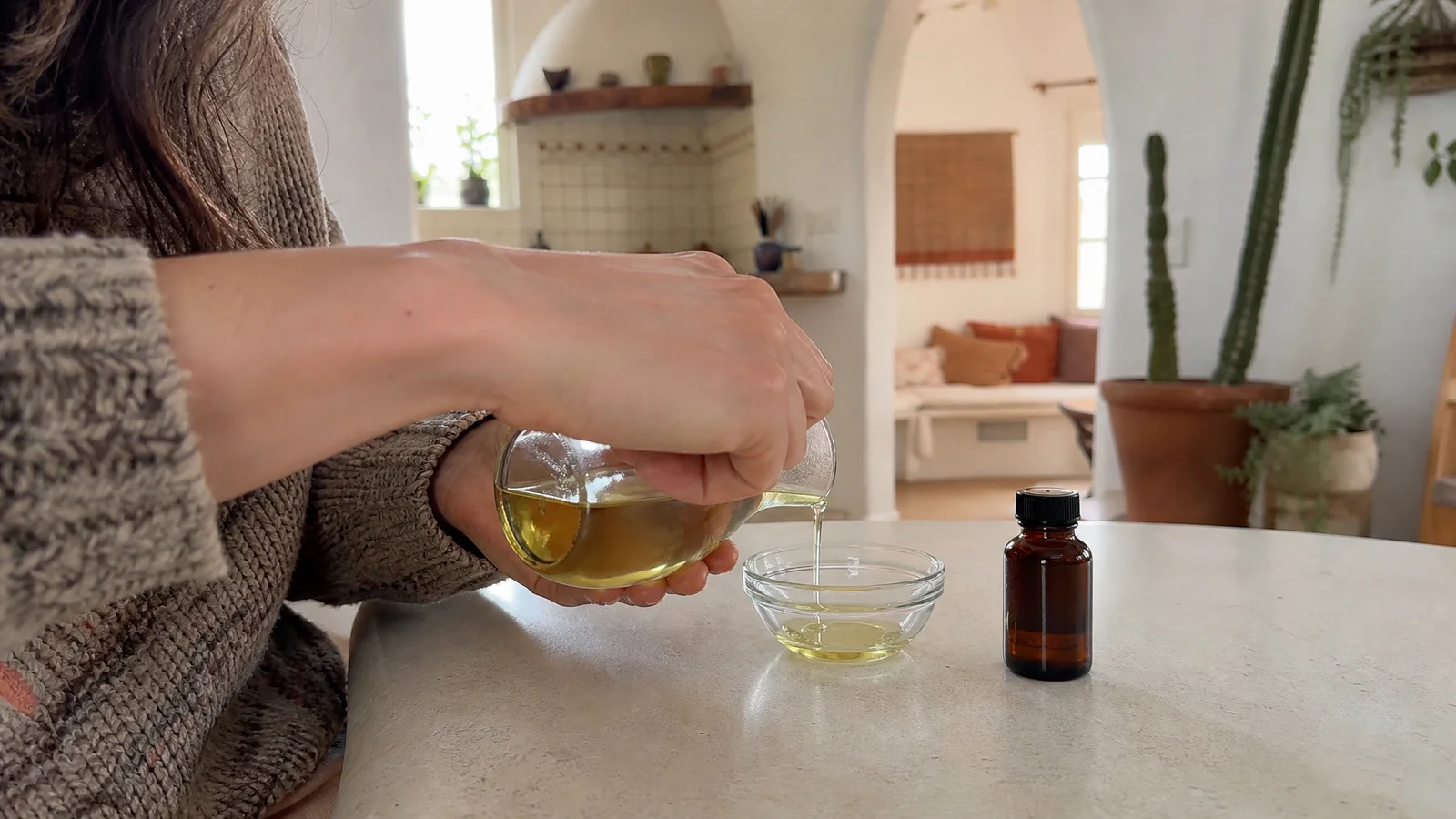
- Measure the carrier into a clean, dry glass bottle first.
- Add the essential oil, cap the bottle, and roll it gently to mix.
- Label it with the contents, percentage and date. Do not rely on memory.
- Patch test on a small area of skin before wider use, as our shop advises, and stop at any sign of irritation.
Patch-test instructions vary between sources, so we will not invent a timing. A dermatologist or pharmacist can give you a protocol that fits your skin. The FDA also notes that many plants contain materials that are toxic, irritating, or likely to cause allergic reactions when applied to the skin, so "natural" is not a safety guarantee.
Old oil and storage change the math
The Tisserand Institute explains that essential oils react with oxygen over time, forming oxides and peroxides that can raise the risk of skin reactions, and that heat, light, moisture and extra air in the bottle speed this up. Its guidance is that most oils keep well for at least 1 to 2 years before oxidation takes effect, and that citrus oils may turn cloudy when moisture gets in; see its page on oxidized essential oils. Our shop page says the oil typically holds its character for 2 to 3 years unopened. Those two figures are not identical, and neither is a guarantee for your particular bottle.
Our practical reading: dilute oil you have recently opened, keep it capped, dark and cool (see how to store lemon eucalyptus oil), and do not put a bottle on skin if its scent has gone flat or off. Dilution does not repair an oil that has aged.
Who should not use a diluted blend, and when to skip it
Our shop page says to keep the oil away from eyes, children and pets, and not to take it internally. Dilution does not change those rules. Do not use these blends on young children or around cats and dogs; our article on pets and lemon eucalyptus oil covers why. If you are pregnant or breastfeeding, ask your OB-GYN or midwife first.
If the oil gets in someone's eyes, or is swallowed, call Poison Help at 1-800-222-1222, which poison.org lists as a free, expert and confidential line, and call 911 if the person collapses, has a seizure or has trouble breathing. For skin reactions, see our guide to lemon eucalyptus skin irritation.
Perfumery versus skin: different jobs, different numbers
Our older article on diluting lemon eucalyptus oil for perfumery and home fragrance covers alcohol sprays, room mists and fragrance blending, where the oil percentages are chosen for scent throw. This page is the skin and carrier-oil angle only. If the two ever disagree for a leave-on skin product, use the 0.5% to 2% range here.
Why not make a bug spray this way?
Because the number on the label is not the problem. Even a carefully calculated blend is not a registered repellent, and its performance as one has not been shown. We give no recipe and no dose for that purpose. For the reasoning, read why DIY lemon eucalyptus bug spray is not the same as an OLE repellent, and for a label-by-label way to judge a registered product, see our guide to oil of lemon eucalyptus.
Is 2% safe for everyone?
No. It is the top of our shop's range, not a universal safe level. Tisserand's generic range for sensitive skin is 0.2% to 1%, and a dermatologist can advise anyone with reactive skin.
How many drops of lemon eucalyptus oil are in a teaspoon of carrier?
A teaspoon is about 5 mL. At 1%, that needs about 0.05 mL of oil, which is 1 to 1.5 drops depending on drop size. That is why small batches are hard to dose accurately.
Can I use the diluted oil on my children?
Our shop advises keeping the oil away from children. Ask a pediatrician before using any essential oil product on a child.
Does diluting it make it repel insects?
No. Dilution only changes concentration. CDC does not recommend pure lemon eucalyptus oil as a repellent, and we do not sell a repellent.
Last reviewed: October 2026
Lemon Eucalyptus Essential Oil
Lemon Eucalyptus Essential Oil from our own shop, in sizes from 0.5 oz to bulk.
From $9.99
Shop Now →