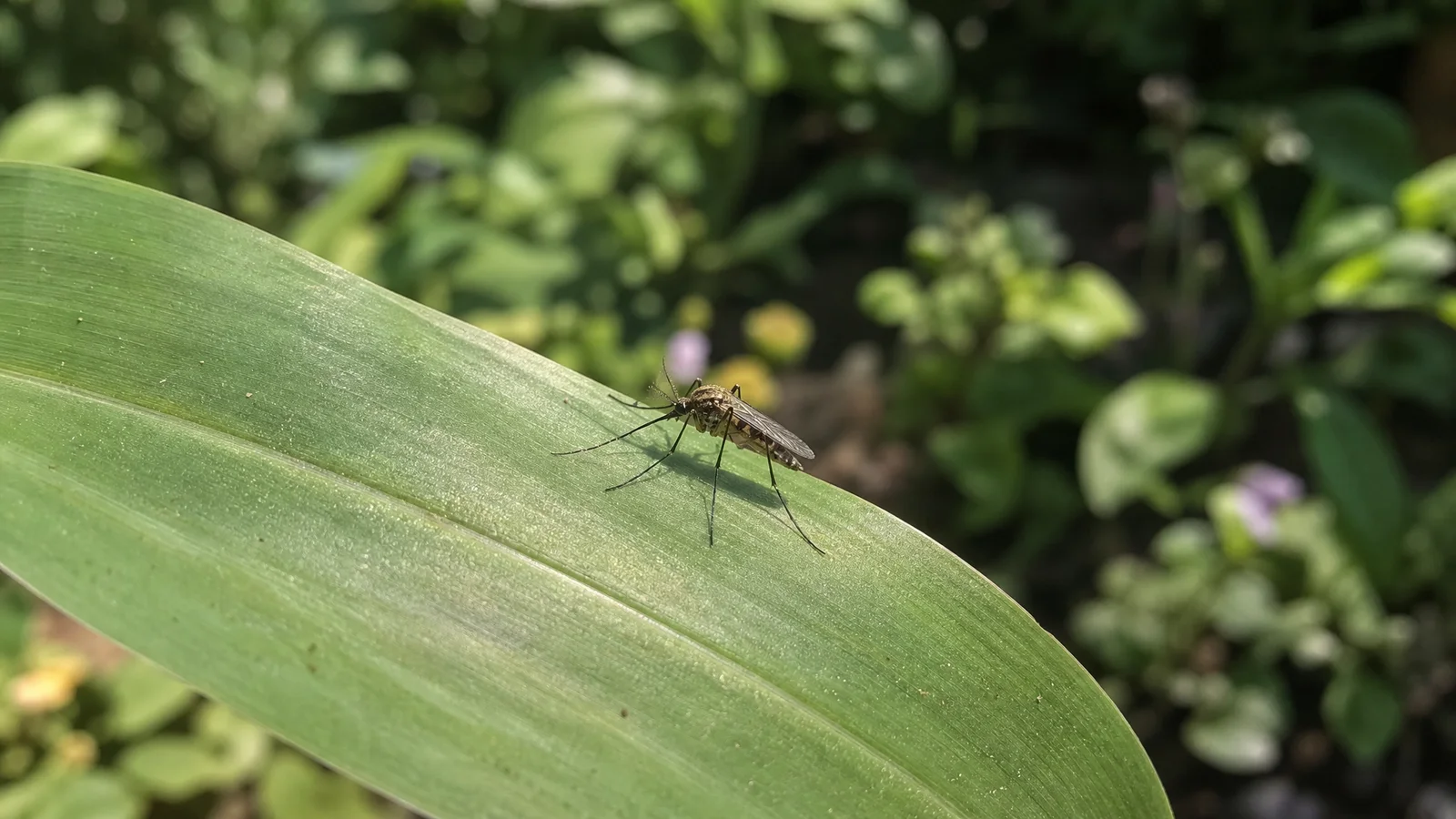
How Mosquito Repellents Work (and How Mosquitoes Find You)
Mosquitoes find people mostly by smell, guided by carbon dioxide from breath, skin odors, body heat and humidity. Repellents interfere with that process, but researchers still disagree on exactly how. For DEET alone, studies propose masking, direct avoidance and contact avoidance. For lemon eucalyptus-derived PMD, no settled mechanism has been published that we could find.
Lemon Eucalyptus Essential Oil
Our own Lemon Eucalyptus Essential Oil, in sizes from 0.5 oz to bulk.
From $9.99
Shop Now →That uncertainty is not a reason to doubt registered repellents. It is a reason to be suspicious of any page that explains "how it works" with a single tidy sentence. This article lays out what mosquitoes are responding to, the main competing explanations, the places where the research genuinely conflicts, and what that means when you choose a product. If you want the ingredient background first, start with our guide to oil of lemon eucalyptus.
How mosquitoes find you
A 2022 review in Trends in Parasitology summarizes the picture: female mosquitoes use chemical and physical cues, including vision, smell, heat and humidity, to orient toward a host. Body odor comes from skin bacteria that convert metabolites in sweat into odorants, and mosquitoes detect those compounds with receptors on the antennae. The brain then combines smell with temperature, humidity and sight to decide where to go.
Carbon dioxide is the best-known cue, and a 2014 study in Cell shows why no single cue is the whole story. Researchers mutated a carbon dioxide receptor gene in Aedes aegypti. The mutants lost their responses to carbon dioxide and also failed to show carbon dioxide-triggered responses to heat and lactic acid, a human-derived attractant, which suggests carbon dioxide helps gate other cues. Yet in a large semi-field enclosure, the mutants' attraction to live humans was only slightly impaired, while their response to an animal host dropped sharply. The authors concluded that heat and odor cues can drive host seeking even without carbon dioxide detection.
The practical meaning is that a mosquito has several ways to find you, and no known product switches all of them off. Differences between people add another layer. A 2021 review describes pregnancy, skin microbiota, diet and genetics as factors that change attractiveness, while calling the evidence modestly understood and in places controversial. Our companion piece, why mosquitoes bite some people more, takes that up.
Four explanations for how repellents work
Most mechanism research has focused on DEET, because it has been the benchmark for decades. The table lists the four lines of work we could open and verify, with their limits.
| Explanation | Study | What it reported | Limits |
|---|---|---|---|
| It jams or masks odor receptors | Ditzen, Pellegrino and Vosshall, Science, 2008 | DEET blocked responses of olfactory neurons to attractive odors in Anopheles gambiae and fruit flies, and inhibited an odorant receptor complex that needs the OR83b co-receptor. | Much of the work used fruit flies and isolated receptors, not mosquitoes biting people. |
| Mosquitoes smell it directly and avoid it | Syed and Leal, PNAS, 2008 | Single-neuron recordings in Culex quinquefasciatus found a neuron that responded to DEET in a dose-dependent way. The authors argued that earlier "masking" results partly came from odorants sticking to DEET-coated stimulus cartridges. | One species, one neuron type, and the authors also saw a "fixative" effect on skin odor. |
| It repels on contact, through the legs | Dennis, Goldman and Vosshall, Current Biology, 2019 | In Aedes aegypti, DEET acts through three distinct routes, smell, ingestion and contact, and contact repellency is mediated by the leg segments, not the mouthparts. | Tested in one species. Explains avoidance after landing, not before. |
| It hides human odor from the antenna | Afify and colleagues, Current Biology, 2019 | In Anopheles coluzzii, DEET, IR3535 and picaridin lowered neuron responses when mixed with human-derived odors, and the authors proposed that they reduce the amount of odor reaching the antenna. | Proposed mechanism for synthetic repellents in malaria mosquitoes, not a universal rule. |
Where the research disagrees
These explanations are not neatly compatible, and the authors say so. Syed and Leal open their paper by noting that DEET's mode of action "still draws considerable debate." Dennis and colleagues call it "both complex and controversial," and conclude that DEET works by more than one route. In 2016, Nature retracted a 2013 paper that had proposed a DEET-sensing receptor in fruit flies, a reminder that the field has corrected itself more than once.
A fair reading is that several mechanisms probably operate at once, with the balance varying by species and context. We would be wary of anyone who claims a single, final answer.
Where lemon eucalyptus and PMD fit
PMD, the active ingredient in refined oil of lemon eucalyptus, was developed from the spent product of distilling lemon-scented gum leaves, according to a 2006 review that describes its history and mosquito performance. CDC lists both OLE and PMD among its recommended active ingredients for EPA-registered products. It does not recommend "pure" lemon eucalyptus oil, which it says has not undergone validated testing and is not registered with EPA as a repellent.
Direct mechanism work on PMD is thinner than on DEET. A 2025 study in Malaria Journal compared commercial products on Anopheles mosquitoes using behavior tests, antennal neuron imaging and measurements of airborne chemicals. Natural products, including PMD and essential-oil products, performed better than synthetic ones in the fastest odor-based tests. In longer tests that allowed odor to accumulate, both did well, and the PMD products were consistent in both. Synthetic products kept their odor concentrations up longer, while the more volatile natural products faded faster. The most effective products, the authors report, often combined masking with odor repellency, activated several antennal neurons and evaporated slowly.
That study used specific commercial products and one mosquito group in laboratory conditions, so it is not a verdict on every lemon eucalyptus repellent. It does give a coherent picture: how much vapor stays near the skin, and for how long, seems to matter. The same 2019 work that supports masking found that two natural compounds, lemongrass oil and eugenol, strongly activated a few antennal neurons at low concentrations in the lab. A neuron lighting up in a dish is not the same as a person staying unbitten, and we would not read it as evidence for any essential oil.
What the mechanism tells you to do
This section is our reasoning from the sources above, not a set of tested results. We have not run bite tests of our own.
- Choose by registration, not by origin. The research says "natural" compounds can excite mosquito neurons, and CDC says the effectiveness of non-registered repellents, including some natural ones, is unknown. Registration is the dependable signal. How to read an insect repellent label shows where to find it.
- Expect to reapply. If protection depends on vapor near the skin, and volatile products fade faster, a time-limited label claim is what you would predict. EPA notes that protection times differ between products because testing conditions differ.
- Do not rely on devices that have no mechanism. CDC's Yellow Book states that ingesting vitamin B or garlic, wearing sound-emitting devices and wearing repellent-impregnated wristbands are ineffective. Our page on mosquito repellent myths goes through them one at a time.
- Remember what repellents cannot hide. Heat and carbon dioxide are still there, so a repellent lowers biting without erasing you. Clothing coverage is a sensible partner, though that is our inference rather than a finding quoted here.
- Compare actives side by side. The differences between DEET, picaridin, IR3535 and OLE show up in label times and age limits, which we compare in our ingredients guide.
Frequently asked questions
Do repellents work by smell alone?
Not necessarily. The 2019 Aedes study found DEET acts through smell, ingestion and contact, and that contact repellency runs through the legs. Other studies focus on the antenna. The evidence points to multiple routes.
Is the mechanism of oil of lemon eucalyptus known?
We found no study that settles it. What exists is performance data on PMD against several mosquito groups and a 2025 comparison suggesting that slow evaporation, masking and neuron activation all play a part in the best products. For the efficacy side, see does lemon eucalyptus repel mosquitoes.
Does smelling strongly lemony mean a product works?
No source we opened links scent strength to protection. The ingredient that matters is the registered active, and the label states its percentage and the protection time the maker claims.
Is the essential oil you sell a repellent?
No. It is a steam-distilled aromatic oil, and our stance page says it is not a registered repellent. The refined, registered ingredient is a different material, explained in OLE versus lemon eucalyptus essential oil. If you are here for scent, our shop has the oil.
Last reviewed: October 2026
Lemon Eucalyptus Essential Oil
Lemon Eucalyptus Essential Oil from our own shop, in sizes from 0.5 oz to bulk.
From $9.99
Shop Now →Sources & Further Reading
- Coutinho-Abreu IV, Riffell JA, Akbari OS. Human attractive cues and mosquito host-seeking behavior. Trends Parasitol, 2022
- McMeniman CJ et al. Multimodal integration of carbon dioxide and other sensory cues drives mosquito attraction to humans. Cell, 2014
- Ellwanger JH, Cardoso JDC, Chies JAB. Variability in human attractiveness to mosquitoes. Curr Res Parasitol Vector Borne Dis, 2021
- Ditzen M, Pellegrino M, Vosshall LB. Insect odorant receptors are molecular targets of the insect repellent DEET. Science, 2008
- Syed Z, Leal WS. Mosquitoes smell and avoid the insect repellent DEET. PNAS, 2008
- Dennis EJ, Goldman OV, Vosshall LB. Aedes aegypti mosquitoes use their legs to sense DEET on contact. Curr Biol, 2019
- Afify A et al. Commonly used insect repellents hide human odors from Anopheles mosquitoes. Curr Biol, 2019
- Retraction: Odour receptors and neurons for DEET and new insect repellents. Nature, 2016
- Nguyen MN et al. Odor repellency and neuronal responses of commercial products towards Anopheles mosquitoes. Malar J, 2025
- Carroll SP, Loye J. PMD, a registered botanical mosquito repellent with deet-like efficacy. J Am Mosq Control Assoc, 2006
- CDC Yellow Book: Mosquitoes, Ticks, and Other Arthropods
- EPA: Find the Repellent that is Right for You