How to Dilute Lemon Eucalyptus Oil: Formula and Tips
A little lemon eucalyptus oil goes a long way, and that is the whole point of dilution. The oil is concentrated, bright and citronellal-rich, so for anything that touches skin the sensible move is to mix a few drops into a carrier oil and let the carrier do the spreading. The arithmetic is simple once you see it laid out.

Lemon Eucalyptus Essential Oil
Our own Lemon Eucalyptus Essential Oil, in sizes from 0.5 oz to bulk.
From $9.99
Shop Now →Our starting point, and why we begin low
We sell this oil neat, so the dilution math is yours to do. Our guidance for topical use is 0.5% to 2% in a carrier oil, with a patch test on a small area first, and to stop if irritation occurs. Citronellal, the main character in this oil, is a recognized skin sensitizer for some people, which is a good reason to be gentle.
For comparison, the Tisserand Institute offers general ranges that apply to essential oils as a class: 0.2% to 1% for sensitive or impaired skin, 0.5% to 1.2% for facial cosmetics and deodorants, 1% to 3% for body oils and lotions. Its rule of thumb is to start low and raise the concentration only if needed. Weighing both, we would begin at 0.5% on anything new, and stay at the lower end for the face and for anyone with reactive skin. Higher is not better here, and 2% is a ceiling, not a target.
The formula
Percent is a share of the finished blend. A 1% blend is 1 part oil to 99 parts carrier. To find the oil you need: batch volume in mL times the percentage, divided by 100. For 30 mL (1 fluid ounce) at 1%, that is 0.3 mL.
The only wobbly part is turning milliliters into drops. The Tisserand Institute notes that across three studies the average weight of 20 drops of essential oil was 0.66 g, while the number of drops per milliliter ranged from about 20 to 40. Its own chart assumes 30 drops per mL. A drop, in other words, is never a precise measure. Using 30 drops per mL as the working figure, here is our arithmetic for 30 mL of carrier:
| Dilution | Oil needed | Roughly, in drops |
|---|---|---|
| 0.5% | 0.15 mL | 4 to 5 |
| 1% | 0.3 mL | 9 |
| 2% | 0.6 mL | 18 |
If your dropper gives 20 drops per mL, take about two-thirds of those drop counts; if it gives 40, go up by a third. To find yours, count how many drops of a plain carrier oil it takes to fill 1 mL, then use that number every time. For very small batches, such as 10 mL at 0.5%, the answer is about a drop and a half, which you cannot dispense, so it is easier to make a slightly larger batch you will use up or to measure by volume with a syringe or by weight with a small scale.
A worked example, step by step
Say you want 30 mL at 0.5%. Here is the order we would follow:
- Start with a clean, dry 30 mL bottle and label it before you add anything: the oil, the percentage, the carrier and today's date.
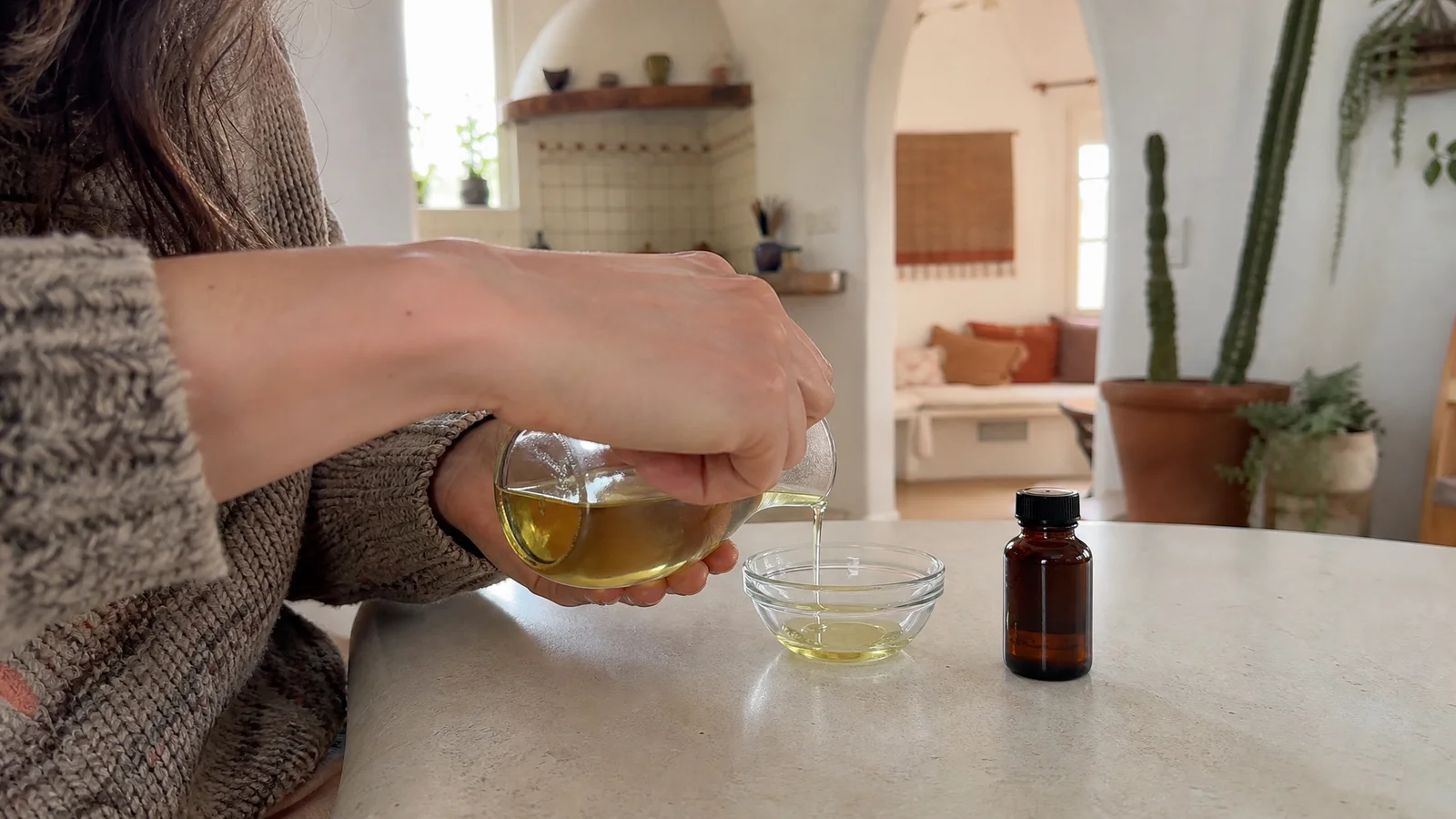
- Pour in the carrier oil first, leaving a little room at the top.
- Add the lemon eucalyptus drops last, about 4 to 5 using the working figure above.
- Cap it, then roll the bottle gently between your palms for a few seconds to mix.
- Open it and take a gentle sniff. You'll notice the lemon is soft and quiet at 0.5%, which is exactly the point.
Choosing a carrier
A carrier is a plain vegetable oil that holds the essential oil and spreads it on skin. We do not sell carrier oils, so you will find jojoba, sweet almond and others at craft-supply shops and grocery stores. A few simple tips apply:
- Pick one you already tolerate, and read its label. Nut-derived carriers are a different decision for someone with a nut allergy, which is a question for an allergist.
- Lightly scented carriers let the bright lemon note come through. That is our preference, not a tested result.
- Do not dilute in water. Oil and water separate, so the concentrated oil would float and land on skin in patches. That is simple chemistry rather than a study finding.
The patch test and common sense
Put a small amount of the finished blend on a small patch of skin, such as the inner forearm, and wait. If you see redness, itching or any discomfort, stop and wash the area with soap and water. Keep the oil away from eyes, children and pets, and do not take it internally. If you are pregnant, nursing or have a medical condition, please check with your physician first. Anyone with eczema or a history of fragrance reactions should speak to a dermatologist before using essential oils on skin.
Give the patch test a little time before you decide anything, and do it on a day when you are not rushing. A small bottle with a clear label is easier to trust than a mystery jar at the back of a drawer.
It also bears saying that dilution makes an oil gentler to wear and does not turn it into an insect repellent. We sell an essential oil, not a registered repellent, and CDC does not recommend using "pure" oil of lemon eucalyptus as one. Our guides to OLE versus the essential oil and what this oil is good for pick up from here.
Start small, label your bottle with the percentage and the date, and you will have a pleasant, repeatable blend every time.
Lemon Eucalyptus Essential Oil
Lemon Eucalyptus Essential Oil from our own shop, in sizes from 0.5 oz to bulk.
From $9.99
Shop Now →