Diffusing Lemon Eucalyptus Around Pets: What to Know
Citrus and eucalyptus together make a lovely room scent, bright, green and a little camphorous. If you share your home with a cat, a dog or a bird, though, the diffuser deserves a moment's thought first. Most diffusing advice is written for people with a footnote about animals. Here we start with the animals and work back to the scent.

Lemon Eucalyptus Essential Oil
Our own Lemon Eucalyptus Essential Oil, in sizes from 0.5 oz to bulk.
From $9.99
Shop Now →What the pet sources say
ASPCApro's guidance for veterinary professionals is plainspoken. Do not use an essential oil diffuser in the house if there are birds, because birds are more likely to suffer respiratory effects from diffusers. Keep diffusers and warmers out of pets' reach, and make sure pets can leave the area if the smell gets too strong for them. Avoid diffusers where there is a pet with an underlying health problem, particularly a respiratory one. And do not keep a diffuser in the same room as animals that groom themselves.
The same page makes a broader point that helps explain the rest: generally, oral and dermal exposure are more concerning than inhalation, except in birds and animals with respiratory issues. It also notes that cats, rabbits, guinea pigs and hamsters may be more sensitive to skin exposure because of the grooming that follows.
Why fur matters as much as air
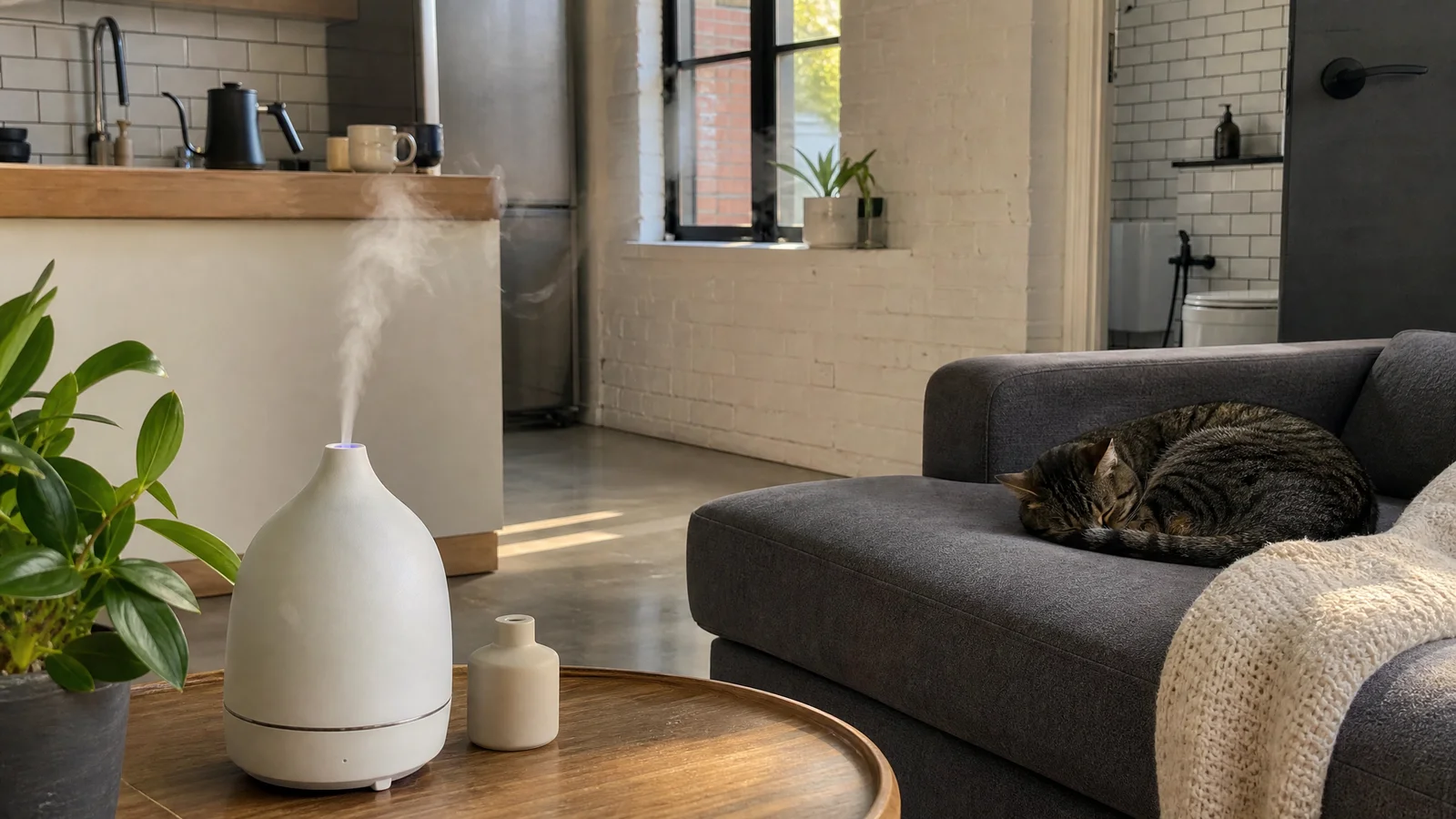
Pet Poison Helpline draws a useful line between two kinds of diffuser. Passive ones, such as reed diffusers and candles, do not put droplets of oil into the air. For these, the main hazard to cats and dogs is respiratory irritation, unless oil gets on an animal or is swallowed, for instance if the diffuser tips over. Active ones, meaning nebulizing and ultrasonic units, release microdroplets or particles into the air. Those can settle on a pet's fur in the same room, and the oil can then be absorbed through the skin or swallowed when the animal grooms itself or others.
That is the idea we would build a house rule around, and it is our reasoning from these sources rather than something either one states as a rule. Think about what an animal might lie in, lick or brush against, not just how strong the room smells. A diffuser beside a pet bed or a favorite perch puts the mist exactly where it lands. A tipped diffuser or a puddle of oil on the floor matters more than a gentle scent in the air.
Pet Poison Helpline describes the signs of respiratory irritation in dogs and cats as a watery nose or eyes, a burning sensation in the nose or throat, drooling or vomiting from nausea, and coughing, wheezing or difficulty breathing. A coughing cat crouches low with little abdominal movement and brings up no hairball. If you see any of this, move the animal into fresh air, and call your veterinarian if it does not clear quickly.
Making it a gentle habit
None of the sources gives a minute count, a room size or a number of drops, and we will not invent one. Here is how we would approach it, labeled as practical reasoning:
Think of the diffuser as a guest in a home that already has residents. A good guest is small, tidy, quiet and easy to send home, and a good diffuser habit has the same qualities.
- Leave the door open so an animal can walk out. A pet shut in with an active diffuser is the setup the sources warn about.
- Choose a room you are in and can air out afterward, and open a window when the session ends.
- Follow your diffuser's manual for how much oil to use, and start with its shortest cycle. If the scent is the first thing you notice when you come in from outside, it is stronger than it needs to be.
- Skip overnight sessions. You cannot keep an eye on an animal while you sleep.
- Wipe up spills right away, and keep the bottle and diffuser out of reach of children and pets, as we recommend for all our oil.
Watch your animals as much as you watch the clock. A pet that gets up and leaves the room is telling you something, and the sources agree it must be free to do so. Treat that as your cue to stop the session and open a window. It is a small thing, and it keeps scent time pleasant for everyone in the house.
A quick household guide
| In your home | What the sources suggest |
|---|---|
| Birds | No essential oil diffuser in the house (ASPCApro) |
| Cat, rabbit, guinea pig or hamster | More caution: keep droplets off fur and the diffuser out of reach, and ask your veterinarian |
| Dog | Open door, short sessions, no spills; stop if the dog seems unsettled |
| Pet with breathing problems | Best avoided, or ask your veterinarian first |
| Someone with asthma, a lung condition or pregnancy | Ask their physician before diffusing |
We sell an essential oil for its aroma, and we make no claims that diffusing it cleans the air, repels insects or supports any condition. For more on animals specifically, our pieces on cats and dogs go into the questions owners ask, and for brighter ways to build a scent, try our diffuser blend ideas. Your veterinarian, who knows your animal, always outranks a general article.
The best moments for a diffuser are the ones when you are home and paying attention: a quiet afternoon, a short session, the window cracked and the animals going about their day. That is the version of the habit we would build.
Lemon Eucalyptus Essential Oil
Lemon Eucalyptus Essential Oil from our own shop, in sizes from 0.5 oz to bulk.
From $9.99
Shop Now →