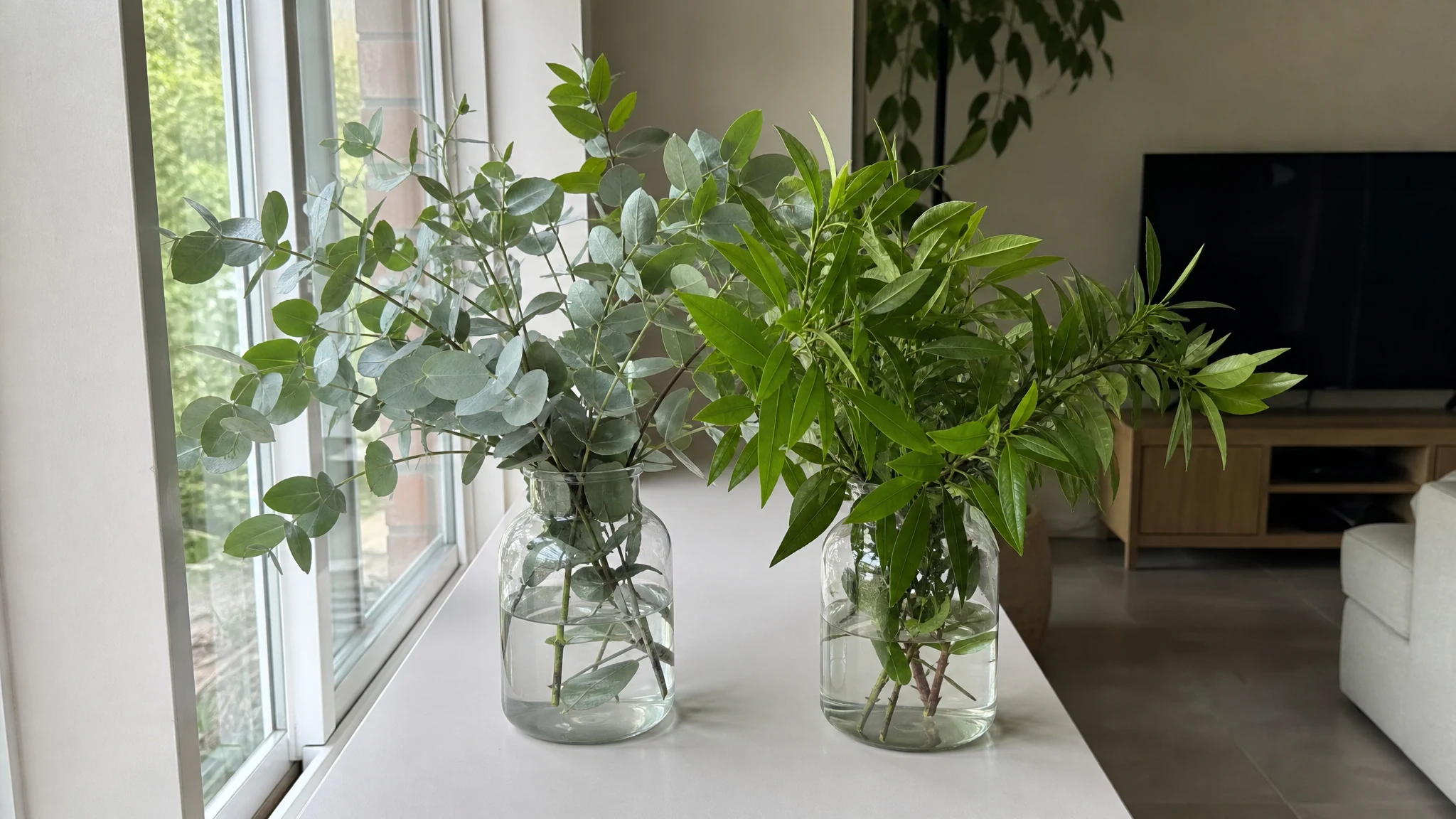
Lemon Myrtle vs Lemon Eucalyptus: Two Kinds of Lemon
Australia gave the perfumery world two famous lemon-scented trees, and it is easy to assume their oils are the same bright note in two bottles. They are not. One is built around citral, the molecule that gives lemon candy and lemon zest their sharpness. The other is built around citronellal, with a supporting cast that makes it greener and more layered. Knowing which is which saves you from a blend that comes out the wrong shade of lemon.

Lemon Eucalyptus Essential Oil
Our own Lemon Eucalyptus Essential Oil, in sizes from 0.5 oz to bulk.
From $9.99
Shop Now →Meet the two trees
Lemon myrtle, Backhousia citriodora, is native to a stretch of Queensland's east coast, and a review by Southwell describes it as the highest-content natural source of citral. Its leaf oil is reported to be roughly 80% to 98% citral, in a yield of 1.1% to 3.2% of fresh leaf weight. The review calls the aroma cleaner, fresher and sweeter than the other citral sources it compares.
Lemon-scented gum, Corymbia citriodora, is the tree behind the oil we sell. The same review lists its leaf oil at 65% to 85% citronellal, with an oil yield of 0.5% to 4.2%. Those are literature ranges across many samples. A single study of leaves from a Portuguese arboretum found 36% citronellal, 13% isopulegol, 12% citronellol and 11% 1,8-cineole, a reminder that where a tree grows, when it is harvested and how old the leaf is all move the numbers. The takeaway is a pattern, not a specification.
One note against a chord
If most of an oil is a single family of molecules, it tends to smell focused. Citral oils are exactly that, which is why a lemon myrtle oil reads as an unmistakable, single-minded lemon. Lemon-scented gum oil is a mixture of citronellal, isopulegol, citronellol and cineole in proportions that shift from lot to lot, so it reads as a chord: lemony, fresh and green, with a crisp, lightly camphorous base. That is how we describe our oil, and it is a top note that lifts quickly and gets out of the way of woods and florals. That follows from the published composition. Our articles on citronellal and on isopulegol and citronellol describe the supporting cast.
A label can hide a second chemistry
Here is a detail worth knowing before you buy lemon myrtle from anyone. Southwell notes that a rarer citronellal chemotype of the tree exists, which resembles citronella and lemon-scented gum and is not the citral oil most buyers expect. It does not breed true: seed from a citronellal-type tree gave progeny in a ratio of about 1.05 citronellal to 1 citral. So "lemon myrtle" on a label does not guarantee the sharp citral lemon. Ask the supplier which chemotype it is and for the lot documentation. That is advice we would give for any oil, ours included: if you need composition details for a formulation, ask us in writing through the contact page before ordering.
Skin and swapping recipes
This is where the two oils must not trade places. Southwell reports that, because of toxicity work on citral, topical use below 1% in a formulation is recommended, and that citral-rich oils should be restricted during pregnancy because of a possible teratogenic hazard. Those statements are about citral oils like lemon myrtle. For our lemon eucalyptus oil we recommend diluting to 0.5% to 2% in a carrier oil with a patch test first, and we would start at the lower end. Citronellal is a known skin sensitiser for some people, so this is not an oil to be generous with. Our dilution guide shows the arithmetic. Because each oil has its own sensitising molecule and its own sensible limit, a recipe validated for one is not validated for the other. If you are pregnant, ask your OB/GYN or midwife before using either in a leave-on product.
Choosing for your project
| You are making | Lean toward |
|---|---|
| A diffuser blend with a green, camphor-edged lemon lift | Lemon eucalyptus |
| A room scent with one clear, sweet lemon note | A citral oil such as lemon myrtle, from a supplier who shares the chemistry |
| A woody or herbal blend that needs a bright opener | Lemon eucalyptus, which blends with lemongrass, lavender, cedarwood, peppermint and sweet orange |
We sell lemon eucalyptus only, so for lemon myrtle you will want a specialist supplier. If you are weighing another lemony leaf oil, lemon eucalyptus versus lemongrass covers that choice.
Smell them side by side
If you ever get both oils into the same room, do the paper strip test. Put a drop of each on its own strip and smell them one after the other, with a breath of fresh air in between. The citral oil tends to smell like a single, sweet lemon from start to finish. The lemon eucalyptus strip is the one that seems to change: lemon first, then something greener and a little cooler as the minutes pass. That difference is the whole story of this article, and your nose will make the point better than we can.
A word on mosquitoes
Both trees turn up in repellent conversations, and both need the same care. CDC says it does not recommend using "pure" oil of lemon eucalyptus, an essential oil that is not formulated, as a repellent. What we offer is an aromatic oil, so for bites choose a product with an EPA registration number from the pharmacy or an outdoor shop.
Two trees from the same country, then, and two quite different pleasures: one a clear lemon sweet, the other a green, layered lemon with a little air in it.
Lemon Eucalyptus Essential Oil
Lemon Eucalyptus Essential Oil from our own shop, in sizes from 0.5 oz to bulk.
From $9.99
Shop Now →Sources & Further Reading
- Backhousia citriodora F. Muell. (Lemon Myrtle), an Unrivalled Source of Citral, Foods, 2021.
- Antibacterial, Antioxidant, and Antiproliferative Activities of Corymbia citriodora and the Essential Oils of Eight Eucalyptus Species, Medicines, 2018.
- Mosquitoes, Ticks, and Other Arthropods, CDC Yellow Book.