Judging Lemon Eucalyptus Oil Quality: A Buyer's Checklist
Open a bottle of lemon eucalyptus oil and the first thing you meet is that lemon-meets-leaf aroma. It's lovely, and it is not a reliable judge of quality, because a nose can't tell you where an oil came from or whether anything was added. The good news is that there are a few checks anyone can make, and they take a lot less chemistry than you might expect.

Lemon Eucalyptus Essential Oil
Our own Lemon Eucalyptus Essential Oil, in sizes from 0.5 oz to bulk.
From $9.99
Shop Now →Start with the name
The oil comes from Corymbia citriodora, a species long listed as Eucalyptus citriodora, so either Latin name on a label is correct. Our own listing uses both: the product table gives Eucalyptus citriodora and the description says Corymbia citriodora, the tree's current name. A label that says only "lemon eucalyptus" isn't wrong, but it leaves room for confusion with regular eucalyptus, which is a different oil with a very different, camphor-forward character. If your records or your product need the species spelled out, ask for it in writing.
Why there is no single "right" citronellal number
Citronellal is the compound most responsible for the oil's lemon-leaf signature, and it is tempting to look for a magic percentage. Published analyses point the other way. One laboratory sample from Portugal measured 36% citronellal (Miguel et al., 2018), while a lemon myrtle review that compares related lemon-scented oils lists 65 to 85% citronellal for C. citriodora (Southwell, 2021). A review of the species explains the spread: the oil's composition varies with location, harvest season and the age of the leaves (Goodine and Oelgemoeller, 2020).
So here is how we would use a number. A citronellal figure that differs from one you read elsewhere is a reason to ask a question, not a verdict, and a figure that looks right is not proof of anything either. It is one piece of a lot's story.
What a lab report can and can't show
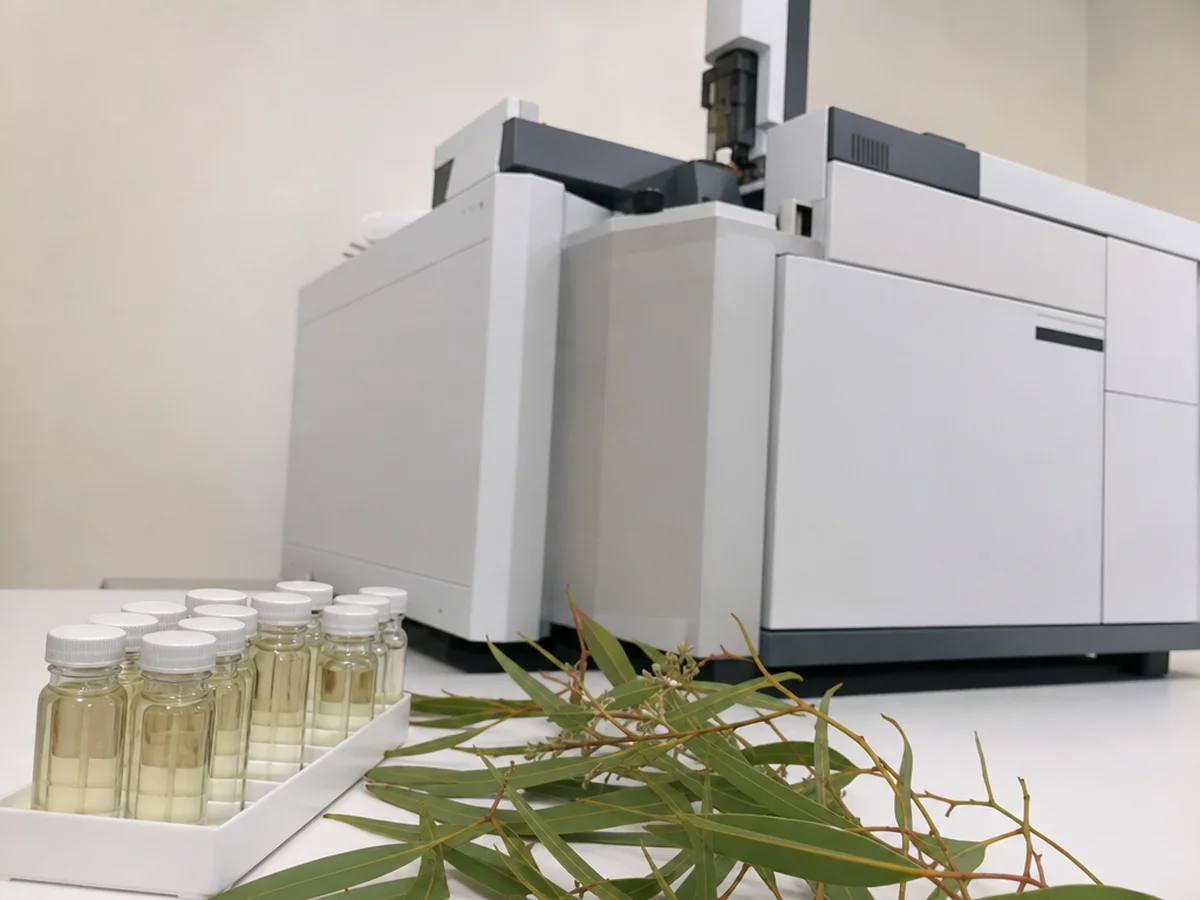
If a seller offers a GC-MS report, which separates an oil into its volatile components, four questions make it useful:
- Is it tied to your lot? A report with no lot number describes a sample, not your bottle.
- Who ran it, and when? A named, contactable laboratory and a date beat an anonymous page.
- Does the profile fit the species? Citronellal should lead, with the supporting cast the literature describes, such as isopulegol, citronellol and 1,8-cineole.
- Is it percent-of-total only, or absolute? This one is the subtle point.
On that last question, a 2021 study of commercial essential oils explains that blending in cheaper oils or synthetic materials can be spotted with normalised percentages or by chiral analysis, but diluting an oil with a vegetable oil changes neither the oil's make-up nor its normalised percentages. Catching that requires absolute quantitation and a reference profile to compare against (Capetti et al., 2021). The study looked at other oils, not lemon eucalyptus, so we treat it as a lesson about the method. In practice a percent-of-total report supports "this is a citronellal-rich eucalyptus-type oil" more strongly than "nothing was added", and we think that is a fair way to read any such document, ours included.
You are welcome to ask us in writing, through the contact page, about batch documentation and citronellal characteristics for the oil you are considering. Our shopper's checklist turns these questions into a quick routine.
A phrase on the label is a description, not a standard
FDA explains that how a product like this is regulated depends mainly on its intended use, judged by its labeling, website and advertising; a product meant to cleanse or beautify is a cosmetic, while one meant for a therapeutic purpose is a drug. In other words, a phrase on a bottle is a seller's description, which is why documents tied to a lot matter more than adjectives. We describe our oil as steam distilled from the leaf and sold undiluted, and we invite the same scrutiny of our words that we suggest for anyone's.
Questions worth asking any seller
- What is the botanical name, in writing?
- Can a document be tied to my lot?
- How should I store it, and how long will it keep?
- What is the smallest size I can try first?
Sellers differ in how readily they answer, and that tells you something too. A clear, specific reply is a good sign; a vague one is worth noting.
A blotter test at home
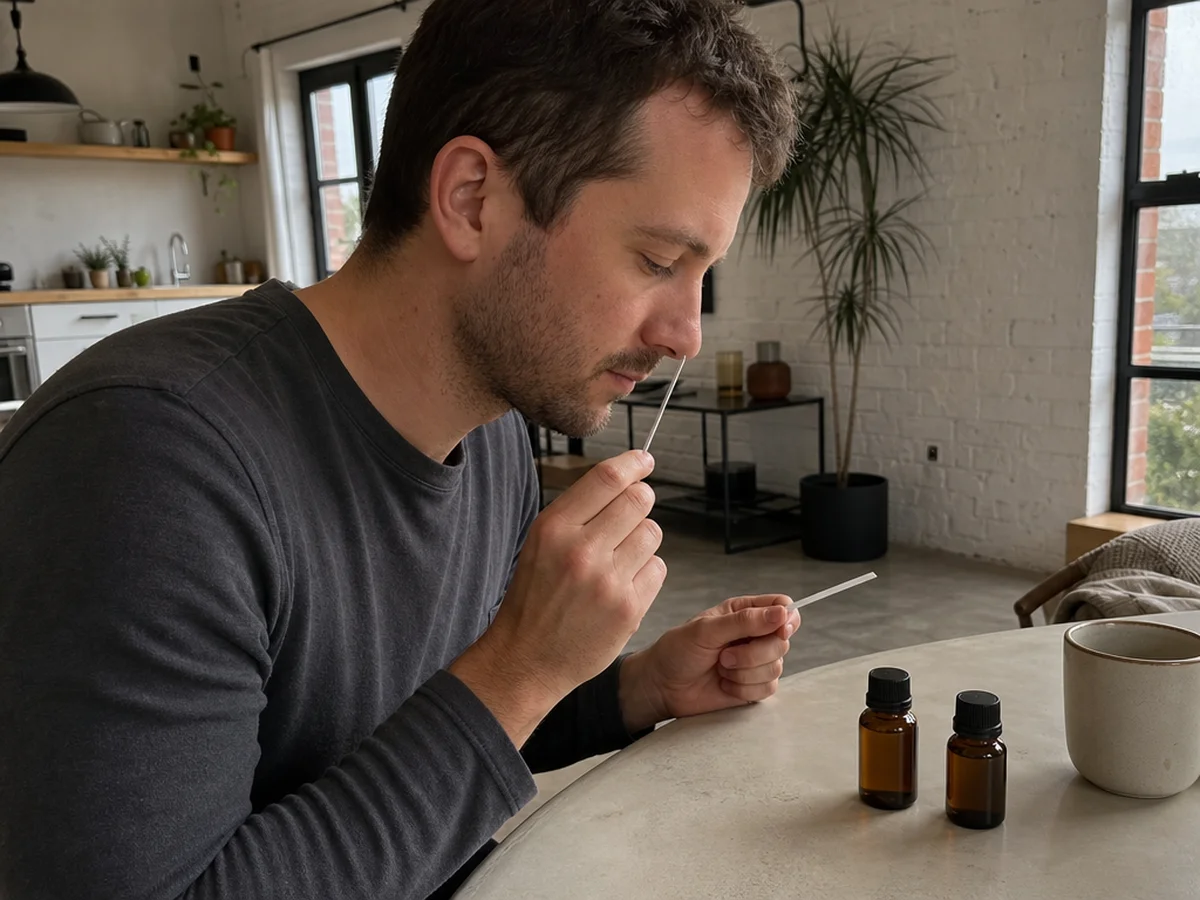
When a bottle arrives, put a drop on a strip of paper and set it beside any bottle you already trust. Smell at once and again after ten minutes. You are looking for a lemon that is bright, a leaf that is green, and nothing sour, musty or flat. Keep a note of the date and your impressions; it becomes your own record for the next order.
Your nose and the calendar
Smell is still worth using. Compare a bottle with one you know, and notice whether the lemon is bright and the leaf is green, or whether it has gone flat. Just remember that age changes scent too. The Tisserand Institute says most essential oils keep well for at least 1 to 2 years before oxidation starts to take effect, and that cloudiness in citrus oils can signal moisture in the bottle. We describe our oil as typically holding its character for 2 to 3 years unopened, capped and away from sun and heat, and our storage guide keeps an opened bottle in shape. For the scent itself, our scent profile describes what to expect.
Check the name, treat numbers as context, read any report for its lot and its method, and trust the document over the adjective.
Lemon Eucalyptus Essential Oil
Lemon Eucalyptus Essential Oil from our own shop, in sizes from 0.5 oz to bulk.
From $9.99
Shop Now →Sources & Further Reading
- Antibacterial, Antioxidant, and Antiproliferative Activities of Corymbia citriodora and the Essential Oils of Eight Eucalyptus Species. Miguel et al., Medicines, 2018.
- Backhousia citriodora F. Muell. (Lemon Myrtle), an Unrivalled Source of Citral. Southwell, Foods, 2021.
- Corymbia citriodora: a valuable resource from Australian flora for the production of fragrances, repellents, and bioactive compounds, Goodine and Oelgemoeller, ChemBioEng Reviews, 2020.
- Adulteration of Essential Oils: A Multitask Issue for Quality Control. Three Case Studies: Lavandula angustifolia Mill., Citrus limon (L.) Osbeck and Melaleuca alternifolia (Maiden & Betche) Cheel. Capetti et al., Molecules, 2021.
- Aromatherapy, US FDA.
- Is my bottle of essential oil oxidized or no longer good to use? Tisserand Institute.