Lemon Eucalyptus Oil in Candles: A Maker's Guide
Lemon eucalyptus smells like a sunny lawn after a shower: crisp citrus on top, green leaf underneath, and a faintly camphorous edge. It is also a top note, the part of a scent that leaves first, which makes it a lovely idea for a candle and a slightly tricky one. If you make candles, a few decisions before you buy will save you wax and time.

Lemon Eucalyptus Essential Oil
Our own Lemon Eucalyptus Essential Oil, in sizes from 0.5 oz to bulk.
From $9.99
Shop Now →Essential oil or fragrance oil?
"Lemon eucalyptus" on a candle supplier's shelf is usually a fragrance oil, a composed scent that comes with a stated flash point and a recommended load for each wax. What we sell is different: the steam-distilled leaf oil of the lemon-scented gum, an essential oil with no standard recipe behind it. We describe the aroma as lemony, fresh and green, and list it as a top note that blends well with lemongrass, lavender, cedarwood, peppermint and sweet orange.
That difference shapes how you work. With a fragrance oil you can copy a supplier's tested load. With a plant oil you are the one doing the testing, and each lot can differ a little. Researchers who measured one Portuguese leaf sample found citronellal, the main aroma compound, at 36% (Miguel et al., 2018), and a review of the species notes that its oil composition varies with location, harvest season and leaf age (Goodine and Oelgemoeller, 2020). A natural-oil candle line is therefore one where you re-check your scent whenever you open a new lot. For how to read what a seller can show you, see our quality article.
Do the weight arithmetic first
Candle scent is measured by weight. Craftybase gives the formula as fragrance weight equals load percentage divided by 100, times wax weight, and works an example: a 320 g batch at a 6% load needs 19.2 g of scent. It also recommends weighing on a digital scale instead of using volume, because fragrance oils are denser than wax and volume measures come out inconsistent. Counting drops is less reliable still, since a drop is a loose unit: the Tisserand Institute found roughly 20 to 40 drops per milliliter across the studies it reviewed.
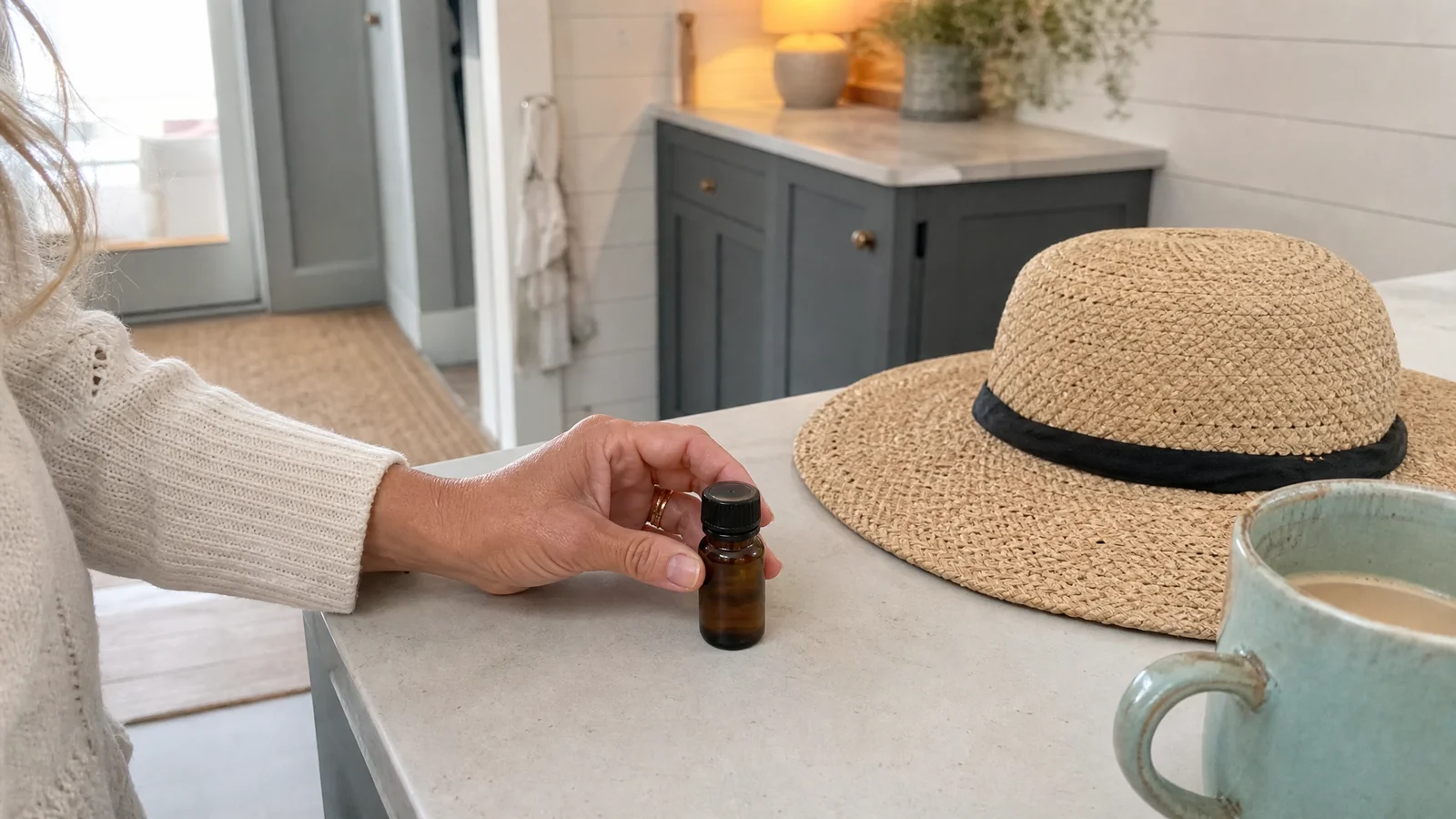
Now compare that with bottle sizes. Our smallest bottle is 0.5 oz, about 14.8 mL. A terpene-rich leaf oil is not expected to be much denser than water (our reasoning, since we are not quoting a density), so the 19.2 g batch could take more than a whole small bottle, and even a 3% load at 9.6 g takes most of it. Treat the 0.5 oz size as a test bottle. If you pour regularly, work out grams per batch from your own recipe, multiply by your batches, and choose among the bigger sizes. Our first-bottle guide explains how to match size to the clock so a large bottle doesn't outlive its freshness.
Temperature and patience
Craftybase suggests most suppliers recommend adding scent to wax at about 180 to 185 F, and that you should add any new scent at least 10 to 15 F below its flash point, which comes from the safety data sheet. It also points out that wax that is too hot burns off the lighter top notes. For a citrus-forward oil like this one, that last point is the practical one: a cooler addition keeps more of the bright note in the jar. Before you rely on a specific temperature for this oil, ask us in writing through the contact page about the safety and batch documentation you need, and in the meantime keep your batches small and never leave heated wax unattended.
Give the finished candle time. Craftybase advises curing for about one to two weeks before judging scent throw. Pour one small test candle at a modest load, let it cure, then judge it cold and lit in the room it is meant for. If the lemon note seems thin, change one thing at a time: load, wick, wax. Blending with a sturdier partner is another route, and our patio candle article and candle and soap maker FAQ cover the making side. Waxes, wicks, jars and the other oils in a blend come from a craft-supply shop.
What to expect from a citrus-green candle
Light it and hold your expectations loosely. A bright top note is at its liveliest in the cold jar and in the first minutes of burning, so it is natural for the scent to feel gentler as the candle burns on. A sturdier note underneath gives the lemon something to rest on.
Notes for your own records
- Wax type and weight.
- Scent load and the temperature you added it.
- Wick and jar.
- Days of cure before you judged it.
Five lines in a notebook turn batch two into a better candle than batch one.
Keep the label about the scent
FDA's aromatherapy page notes that scented candles fall under the Consumer Product Safety Commission rather than FDA's cosmetic rules, and that advertising claims are policed by the Federal Trade Commission. So describe the smell, not what the candle does for a room, a mood or an insect. One point worth knowing: CDC does not recommend using "pure" oil of lemon eucalyptus as a repellent, and a scented candle is a scent product. If you want mosquito protection, an EPA-registered repellent from a pharmacy or outdoor shop is the right tool. Anyone who will burn the candle with small children, pets or fragrance sensitivities nearby is best served by checking with a pediatrician or veterinarian first.
If this oil earns a place in your line, the sensible order is: confirm the species in writing, request the data sheet, test small at a low load, then scale. Our wholesale page describes samples and private label for makers who sell what they pour.
Candle making is part chemistry and part patience, and the patience is the part we enjoy most. Pour small, take notes, and give the jar time to cure.
Lemon Eucalyptus Essential Oil
Lemon Eucalyptus Essential Oil from our own shop, in sizes from 0.5 oz to bulk.
From $9.99
Shop Now →Sources & Further Reading
- Candle Fragrance Load Calculator - Formula, Wax Percentages and Flash Point Guide, Craftybase.
- Aromatherapy, US FDA.
- Antibacterial, Antioxidant, and Antiproliferative Activities of Corymbia citriodora and the Essential Oils of Eight Eucalyptus Species. Miguel et al., Medicines, 2018.
- Corymbia citriodora: a valuable resource from Australian flora for the production of fragrances, repellents, and bioactive compounds, Goodine and Oelgemoeller, ChemBioEng Reviews, 2020.
- How big is a drop? Tisserand Institute.
- Mosquitoes, Ticks, and Other Arthropods, CDC Yellow Book.