Why Lemon Eucalyptus Repellents Say 30%
Almost every registered lemon eucalyptus repellent seems to say 30% on the front. It is a tidy number, and it hides a bit of chemistry. Here is what it measures, why it keeps showing up, and what it can and cannot tell you.

Lemon Eucalyptus Essential Oil
Our own Lemon Eucalyptus Essential Oil, in sizes from 0.5 oz to bulk.
From $9.99
Shop Now →The 30% is not raw oil
The oil of lemon eucalyptus (OLE) in a registered repellent is not the oil that comes straight from the still. Penn State Extension describes it as a synthesized plant oil from the lemon-scented gum tree and, in a footnote, as a synthetic concentration of para-menthane-3,8-diol (PMD), which is the compound that repels some insects and ticks. EPA says on its ingredient page that OLE "contains pmd, but is a separately regulated pesticide chemical." That is why you will see both OLE and PMD as active ingredients on different labels, with six registered products each.
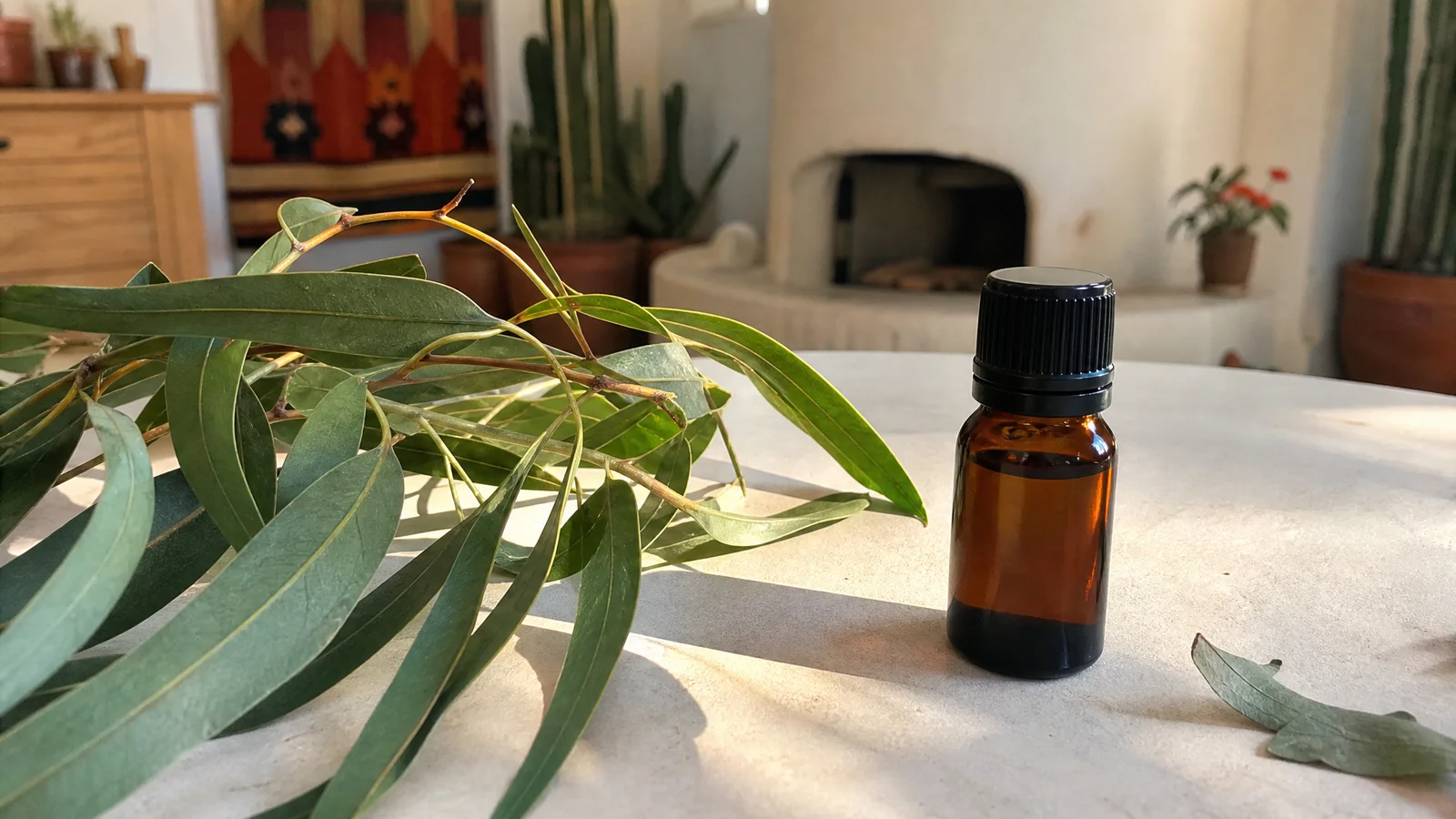
Penn State also points out that plain lemon eucalyptus essential oil lacks the same repellent effect because it contains very little PMD. This is why we keep the two apart. We sell the essential oil, steam-distilled from the leaf, for scent and craft. It is a lovely material and a different one from the refined ingredient behind the 30%.
Why 30 keeps appearing
Penn State lists 30% as the recommended OLE concentration, with protection of about 2 to 5 hours and a recommendation for children 3 and older. The University of Wisconsin's mosquito site adds some background on the PMD side: it reports that 20% PMD gave protection equal to 20% DEET in field studies, that a 10% formulation was not as effective, and that 20% formulations protected for 6 to 8 hours. We draw one practical conclusion, flagged as our reasoning: 30% is a considered middle ground in registered products and not a random figure. We cannot convert one number to the other for you, because the share of PMD in a given OLE depends on the manufacturer, so read the active ingredient box and any footnote.
What strength buys you
CDC states that higher concentrations of active ingredient give a longer duration of protection, regardless of the ingredient, and that products with less than 10% active ingredient might offer only limited protection, often 1 to 2 hours. Wisconsin offers a counterpoint for short outings: lower concentrations of 5 to 10% may be fine for 1 to 3 hours of exposure, with 20% and above better in areas of intense mosquito activity. The two statements fit together nicely. A weaker product suits a quick stroll, a stronger one suits a long, buggy afternoon.
The published times (2 to 5 hours from Penn State, 6 to 8 from Wisconsin) differ because they summarize different studies, so we would not average them. Plan around the low end, and treat the time printed on your own label as the ceiling. Our article on how long a lemon eucalyptus repellent lasts shows how much the species of bug changes the answer.
More is not automatically better
Do not read 60% as twice as good as 30%. CDC notes that for DEET, efficacy tends to peak at about 50%, and we found no source showing that OLE keeps improving with a higher percentage. What a higher number can bring is a stricter label, so follow the printed directions on any product.
Comparing across ingredients
Percentages do not translate between active ingredients. Penn State's guide recommends roughly 25 to 40% for DEET and 10 to 20% for picaridin, next to 30% for OLE, because these are different molecules working in different ways. Compare protection time and age rules instead, as we do in our ingredient comparison. And note the age rule carefully: CDC says not to use products containing OLE or PMD on children under 3.
Reading the front of the box
The big number on the front is the easiest thing to notice and the least complete. Flip the box over. Find the active ingredient panel, the registration number, the pests named and the line about children. If you cannot find them quickly, put the box back and try another; a label that hides the useful parts is not helping you.
It also helps to remember that the percentage describes what is in the bottle, while the time on the label describes how long to expect protection. They are different things, and neither will save your evening if you forget to reapply.
A small shopping tip
Take a photo of the label you like so you can find the same product again, instead of hunting for the box from memory the next time you run out.
Where our 0.5% to 2% fits in
You may have seen our dilution guidance of 0.5% to 2% in a carrier oil for skin use. That is a comfort range for a scented oil, a different idea altogether from a repellent strength. A carrier-oil blend of essential oil is not a registered repellent, and a home mixture that tried to reach 30% would be well beyond any dilution we recommend. If you are blending for scent, how to dilute lemon eucalyptus oil has the arithmetic. If you want a repellent, a pharmacy or outdoor shop carries registered products with the strength and time printed on the label.
A number on a box is a good place to start asking questions, and we would much rather you ask them than guess.
Lemon Eucalyptus Essential Oil
Lemon Eucalyptus Essential Oil from our own shop, in sizes from 0.5 oz to bulk.
From $9.99
Shop Now →Sources & Further Reading
- Tick and Mosquito Repellent Guide (Penn State Extension)
- Skin-Applied Repellent Ingredients | US EPA
- Repellents for Application to Skin, Wisconsin Mosquitoes and Mosquito-Borne Diseases (UW-Madison)
- Mosquitoes, Ticks, and Other Arthropods | CDC Yellow Book
- Preventing Mosquito Bites | Mosquitoes | CDC