Lemon Eucalyptus and Frankincense: A Blend Worth Weighing
Lemon eucalyptus is quick and sparkling; frankincense is slow and resinous. Put them side by side and the pairing practically suggests itself, a bright top note over a settled base. The part blending guides skip is the first step: working out which frankincense you are actually buying.

Lemon Eucalyptus Essential Oil
Our own Lemon Eucalyptus Essential Oil, in sizes from 0.5 oz to bulk.
From $9.99
Shop Now →"Frankincense" is a family, not a single oil
Wikipedia lists the frankincense species as Boswellia frereana (northern Somalia), B. occulta (Somalia), B. sacra (Somalia and South Arabia, also called B. carteri), B. serrata (India) and B. papyrifera (Ethiopia, Eritrea and Sudan). Five trees, several regions. A bottle labelled only "frankincense essential oil" does not tell you which one you have, and the aromas can differ.
So ask your supplier in writing for the species, the country and how the oil was made. We give the same advice for lemon eucalyptus: ask any supplier for botanical-name confirmation and batch documentation. It is a simple habit that tells you quickly how well a seller knows their product.
Method matters too. According to Wikipedia, steam-distilled frankincense oils do not contain boswellic acids, though some solvent extracts may. That is just a point of clarity: whatever you read about those compounds on a supplement label does not carry over to a steam-distilled oil, and we make no health claims about either. We sell only lemon eucalyptus, so the frankincense comes from a supplier of your choice.
Why they sit well together
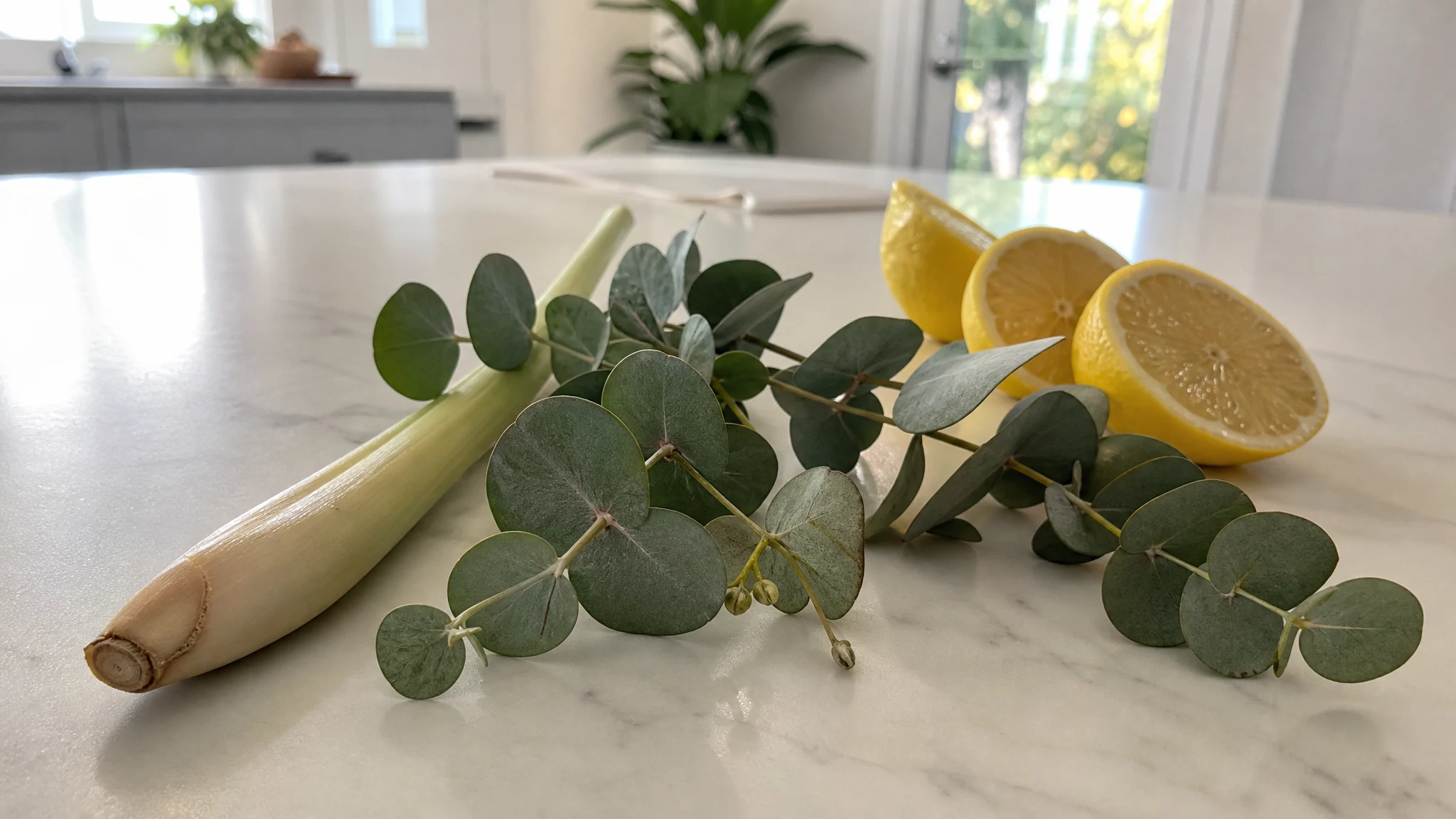
Published numbers for lemon eucalyptus leaf oil vary with the sample. One hydrodistilled sample from a Portuguese arboretum showed citronellal at 36%, with isopulegol, citronellol and 1,8-cineole each in the low teens, while a review table puts citronellal for the species anywhere from 65% to 85%. Frankincense oil, by Wikipedia's account, is mostly monoterpenes, led by alpha-pinene, limonene and beta-pinene. Citronellal and its relatives on one side, pinene and limonene on the other: the two oils do not overlap much, which is a nice argument for giving each its own job. Whether the result smells good is something only a blotter can say. For the way top notes fade ahead of slower materials, see building a blend by evaporation order.
A little about the trees
It is worth knowing a bit about where the resin comes from. Wikipedia describes Boswellia serrata as native to India and into Pakistan and reports that it is at risk from non-sustainable practices, and it notes a 2019 projection of a large decline in B. papyrifera, which supplies a big share of global production. Details about any one supplier's harvesting are not something we can tell you. What we can say is that a supplier who names the region and describes how the resin is harvested is giving you something you can check, and that is the better bottle to blend with.
What to expect on the blotter
Lemon eucalyptus does its talking in the first moments: bright, green, with a touch of camphor. Frankincense arrives slowly, and what it brings depends on the bottle, so keep your expectations loose until you have smelled both. Put each oil on its own blotter first and smell them one after the other, then hold the two blotters together. You may notice a kind of pause between the lemon and the resin, and that pause is the space you are designing.
A trial plan with frankincense as the supporting voice
We suggest weighing instead of counting drops. The Tisserand Institute reports 20 to 40 drops per millilitre across studies, and a thick resin oil will not drip like a thin leaf oil. These are arithmetic starting points for 10 g of combined oil:
| Trial | Lemon eucalyptus | Frankincense | What to listen for |
|---|---|---|---|
| A | 9 g | 1 g | Does a trace of resin change the opening? |
| B | 8 g | 2 g | A comfortable middle |
| C | 7 g | 3 g | Is the resin starting to lead? |
Smell each on a blotter right away, again at ten minutes and again at an hour, and note which one still reads as lemon at the hour mark. Change one variable at a time, and if you later add a third oil, keep the weights from the winner.
Giving the blend a rest
Write the date and the ratio on a label, cap the vial and leave it alone overnight. Come back the next day with a fresh nose and smell it before you read your notes. First impressions of a blend you have just made are bound to be tinted by hope; the next-day sniff is more honest, and it is the one that decides whether you go on to a bigger batch.
If it is going on skin
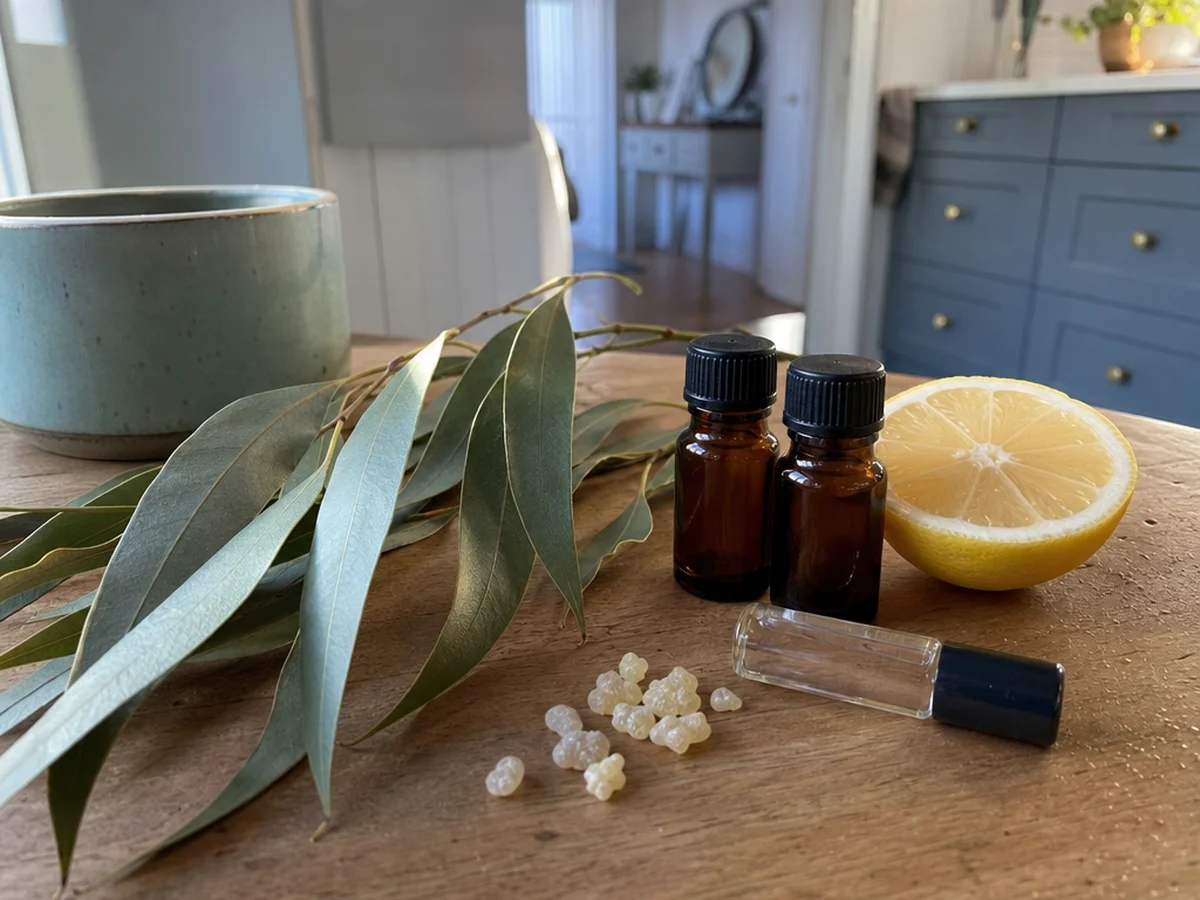
For skin, count all the essential oil in the bottle together. The Tisserand Institute lists 0.2% to 1% for sensitive or impaired skin, 0.5% to 1.2% for facial products and 1% to 3% for body oils and lotions. Our own guidance for lemon eucalyptus is 0.5% to 2% in a carrier with a patch test; because citronellal is a known skin sensitiser for some people, we start at the lower figure and let the most cautious ingredient decide. Our dilution guide shows the arithmetic. Check your frankincense seller's safety data sheet too.
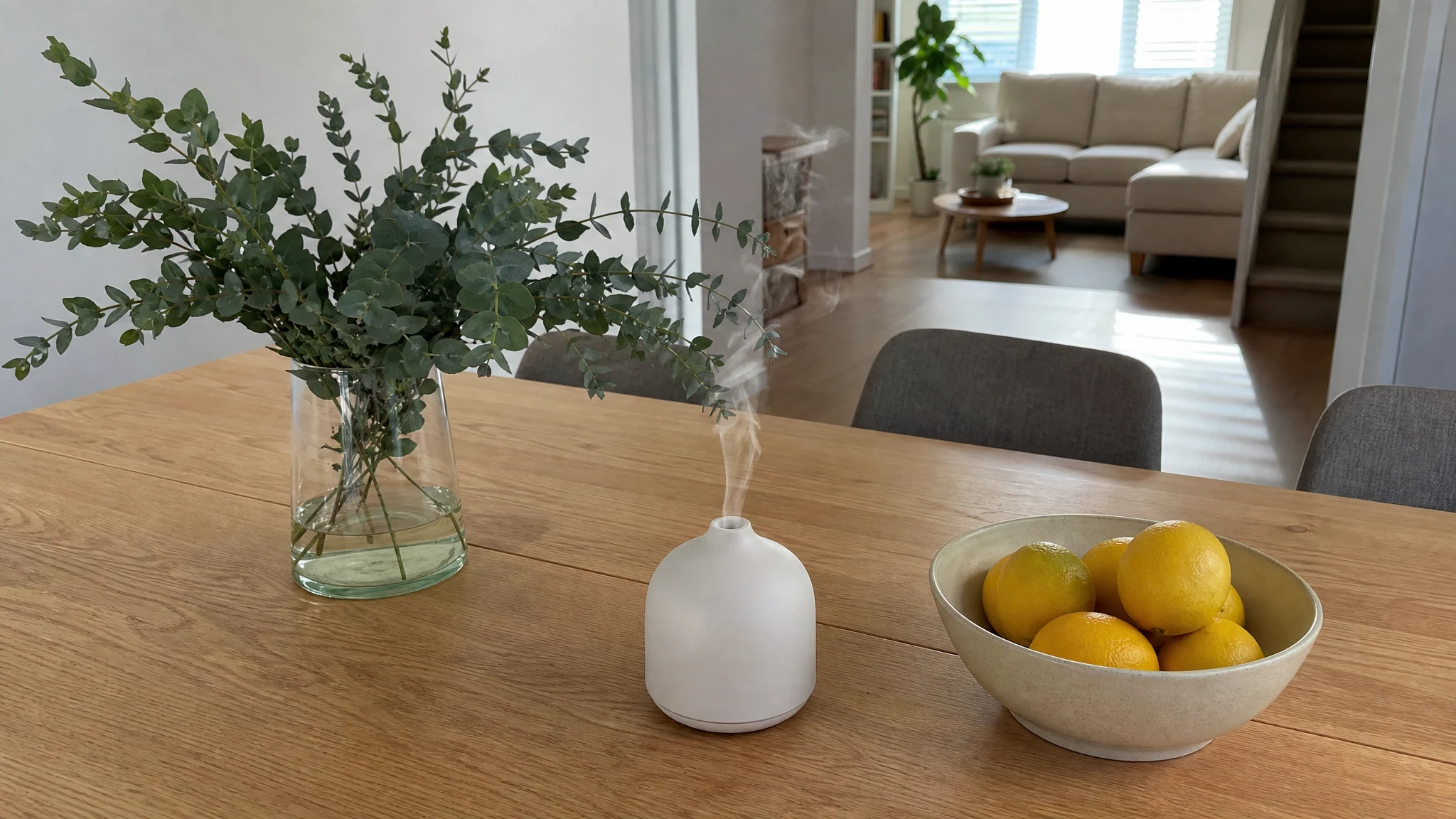
For a diffuser, our diffusing guide covers ventilation, pets and timing, and homes with birds are a good reason to skip diffusing. Keep the oil away from children and pets, and ask a physician if you are pregnant, nursing or have a medical condition. You can read more about the tree behind our oil in our piece on the lemon-scented gum.
This blend is about scent: a bright opening and a resinous hush behind it. Start with the species question, weigh your trials, and the rest is a pleasure to explore.
Lemon Eucalyptus Essential Oil
Lemon Eucalyptus Essential Oil from our own shop, in sizes from 0.5 oz to bulk.
From $9.99
Shop Now →Sources & Further Reading
- Frankincense, Wikipedia
- Boswellia serrata, Wikipedia
- Antibacterial, Antioxidant, and Antiproliferative Activities of Corymbia citriodora and the Essential Oils of Eight Eucalyptus Species, Medicines, 2018 (Miguel et al.)
- Backhousia citriodora F. Muell. (Lemon Myrtle), an Unrivalled Source of Citral, Foods, 2021 (Southwell)
- How big is a drop?, Tisserand Institute
- Dilution for essential oils, Tisserand Institute