Oils That Blend With Lemon Eucalyptus: Picking Partners
Ask which oils go with lemon eucalyptus and you will usually get a list. A more useful answer starts with what the oil is made of, because that tells you why a pairing might sing and what to check before you buy the partner.

Lemon Eucalyptus Essential Oil
Our own Lemon Eucalyptus Essential Oil, in sizes from 0.5 oz to bulk.
From $9.99
Shop Now →What we are working with
Composition varies with the sample. One hydrodistilled leaf oil from a Portuguese arboretum showed citronellal at 36%, with isopulegol, citronellol and 1,8-cineole each in the low teens. A review table puts citronellal for Corymbia citriodora oil at 65% to 85% across studies. We do not quote a composition for our own oil, only that we describe its citronellal as naturally high, so treat the literature as a general guide.
The picture is an aldehyde (citronellal) with a cyclic alcohol, a plain alcohol and an oxide alongside. A partner that echoes one of those has a reason to be tried, and one that adds a strong sensitiser deserves a closer look. A shared molecule does not promise a lovely smell, and the blotter has the final say.
The partners we suggest, and what to ask
We list lemongrass, lavender, cedarwood, peppermint and sweet orange as oils that blend well with lemon eucalyptus. Here is what published sources say about them, and frankincense as an extra.
| Partner | What sources say | Worth checking |
|---|---|---|
| Sweet orange | Over 90% d-limonene, cold-pressed rather than steam-distilled | Limonene oxidises easily, so buy small and fresh |
| Lavender | Linalool and linalyl acetate lead; linalool is about 29% in L. angustifolia and 49% in L. latifolia | Ask which species |
| Peppermint | Menthol is the key component | Menthol may cause serious side effects in infants if inhaled, so skip it in homes with babies |
| Lemongrass | Citral 60% to 90%, a recognised skin irritant and sensitiser at higher levels | Adds a second sensitiser; see our lemongrass comparison |
| Cedarwood | Usually juniper or cypress rather than true cedar | Ask for the botanical name |
| Frankincense | Mostly monoterpenes such as alpha-pinene and limonene | Ask for species and origin; see our frankincense article |
We sell none of these, so buy from a supplier who will name the species and tell you what documentation they hold. Our own lemon eucalyptus oil is in our shop, and our bulk page and guide to buying lemon eucalyptus oil in bulk cover larger quantities.
The most interesting link: isopulegol and menthol
This one is a real chemical story. US patent 7550633 describes isopulegol as made from citronellal and as an important intermediate in making menthol, which comes from hydrogenating isopulegol's double bond. Lemon eucalyptus contains citronellal and isopulegol; peppermint is built around menthol. So there is a documented industrial route from one family of molecules to the other, which makes a "lemon plus cool mint" trial feel less random. The patent says nothing about aroma, so whether it smells good together is for your nose to decide. If a baby lives in the house, set the pairing aside, since the infant caution on peppermint outweighs any chemistry argument.
When shared molecules call for a lighter hand
Components add up. Wikipedia lists oxidised limonene as a skin sensitiser, and the Tisserand Institute says products formed as limonene oxidises tend to increase the chance of skin reactions, which is why fresh citrus bottles matter. A review of lemon myrtle notes that citral is sensitising in guinea pigs and recommends keeping topical use of citral-rich oil below 1%. It concerns lemon myrtle and lemongrass, not our oil, but it is the reason we would not stack lemongrass onto lemon eucalyptus in a leave-on skin blend.
For skin, the Tisserand Institute gives 0.2% to 1% for sensitive or impaired skin, 0.5% to 1.2% for facial cosmetics and 1% to 3% for body products. Our guidance for lemon eucalyptus is 0.5% to 2% in a carrier with a patch test; where the two differ we use the lower figure, and we count all the oils in a blend against a single limit. Our dilution guide gives the arithmetic.
Start with the feeling you want
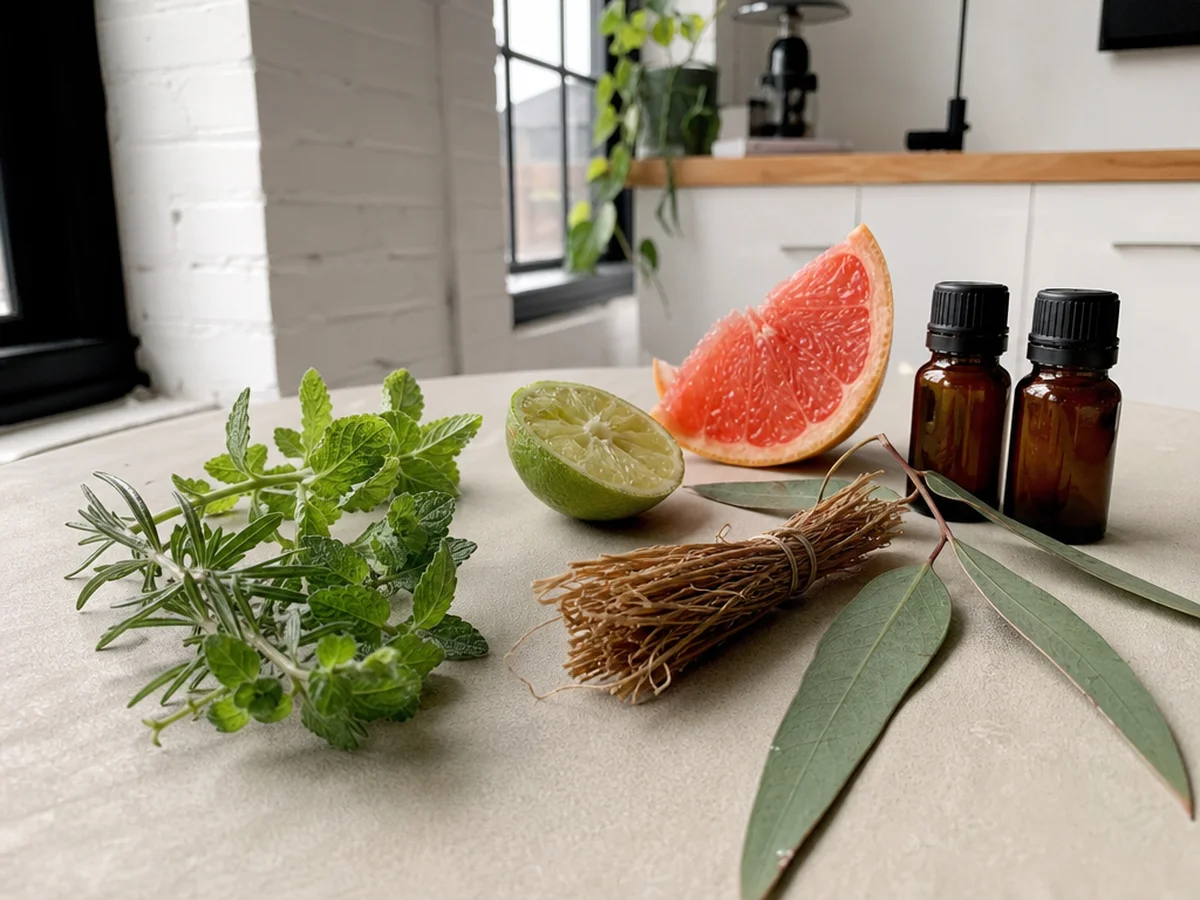
Before you pick a partner, decide how you want the blend to feel. Sunnier and sweeter, greener and herbal, or cooler and cleaner? Sweet orange pushes toward sunny. Lavender leans floral and soft. Cedarwood gives the lemon something dry and woody to stand on. Peppermint adds a cool edge, and lemongrass doubles down on lemon. Thinking in pictures like these makes the shortlist shorter than a list of names would.
Keep a scent notebook
Write down what you tried, the date, and a word or two about how it smelled at the start and an hour later. A page of honest notes beats a good memory, and it is how a happy accident becomes a blend you can make again.
Running a trial
- Choose one partner and get its botanical name in writing.
- Weigh a 10 g trial rather than counting drops; the Tisserand Institute reports about 20 to 40 drops per millilitre.
- Smell it right away, at ten minutes and at an hour. Top notes evaporate quickly, while base notes are usually not noticed until about half an hour in.
- Change one partner at a time and write down the weights.
For the ways trials go wrong, see our blending mistakes article, and for the order things evaporate, building a blend by evaporation order.
A few reminders
Keep our oil away from children and pets, and ask a physician if you are pregnant, nursing or have a medical condition. Pet owners should check with a veterinarian before diffusing, and our diffusing guide covers what we found. These pairings are about aroma. We sell an essential oil, not a registered repellent.
Start with one partner, one small trial and a clean blotter, and let the chemistry give you a reason to be curious.
Lemon Eucalyptus Essential Oil
Lemon Eucalyptus Essential Oil from our own shop, in sizes from 0.5 oz to bulk.
From $9.99
Shop Now →Sources & Further Reading
- Antibacterial, Antioxidant, and Antiproliferative Activities of Corymbia citriodora and the Essential Oils of Eight Eucalyptus Species, Medicines, 2018 (Miguel et al.)
- Backhousia citriodora F. Muell. (Lemon Myrtle), an Unrivalled Source of Citral, Foods, 2021 (Southwell)
- US7550633B2: Method for the production of isopulegol, Google Patents
- Orange oil, Wikipedia
- Limonene, Wikipedia
- Lavender oil, Wikipedia
- Peppermint extract, Wikipedia
- Cedar oil, Wikipedia
- Frankincense, Wikipedia
- Perfume, Wikipedia
- Dilution for essential oils, Tisserand Institute
- Is my bottle of essential oil oxidized or no longer good to use?, Tisserand Institute
- How big is a drop?, Tisserand Institute