Lemon Eucalyptus Repellent Studies: What They Found
When a blog says "studies show lemon eucalyptus repels mosquitoes," the useful follow-up is a short one: which material, which mosquito, and measured how? The studies are real and fairly consistent, but almost all of them are about a refined, registered ingredient rather than the steam-distilled leaf oil in a bottle like ours. Here is what the research actually says, and what it leaves alone.

Lemon Eucalyptus Essential Oil
Our own Lemon Eucalyptus Essential Oil, in sizes from 0.5 oz to bulk.
From $9.99
Shop Now →Three materials share one name
In a study, "lemon eucalyptus" can mean three different things, and evidence does not transfer from one to another.
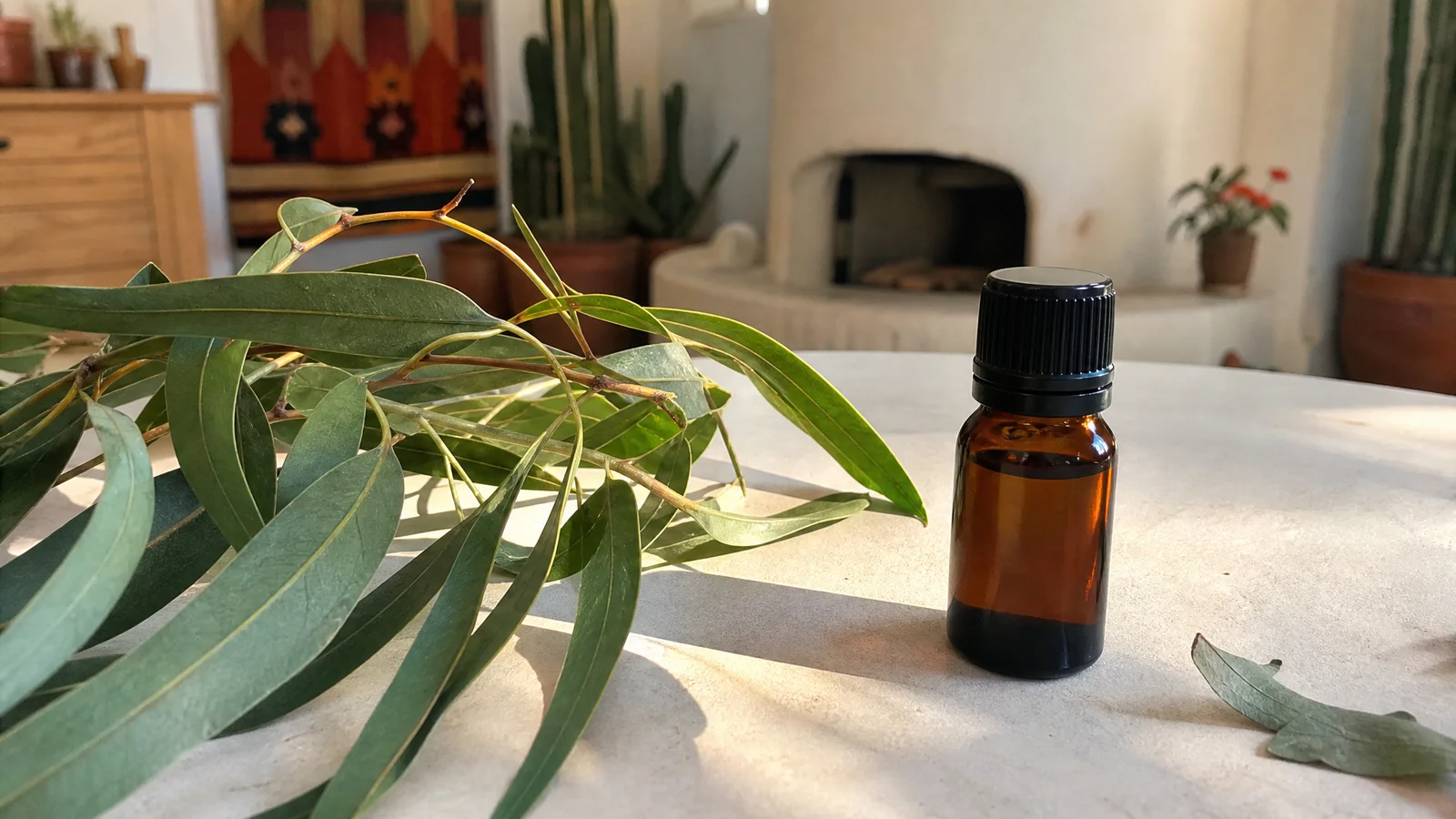
- Lemon eucalyptus essential oil is the steam-distilled leaf oil of Corymbia citriodora. It is what we sell, and it is an aromatic oil, not a registered repellent.
- Oil of lemon eucalyptus (OLE) is a refined extract enriched in para-menthane-3,8-diol (PMD). EPA lists it as a separately regulated pesticide chemical.
- Synthetic PMD is the same molecule made in a factory.
The confusion has a tidy origin. Carroll and Loye describe PMD as a monoterpene that is a spent product of the distillation of leaves from the Australian lemon-scented gum. The registered material and our oil come from the same tree, but one has been processed into a different ingredient. We untangle the label differences in OLE vs lemon eucalyptus essential oil and the chemistry in what PMD is.
What "it worked" can mean
Researchers measure repellents in different ways, and the numbers are not interchangeable. A cage test counts the minutes until the first bite on a treated arm. A wind tunnel counts how many mosquitoes fly toward a person, which is attraction rather than bites. Field trials count landings or bites in real life, and disease trials count actual cases. A product can look strong in one setting and ordinary in another, so it pays to ask which test produced a claim.
The studies, one at a time
| Study | What was done | What it found |
|---|---|---|
| Fradin and Day, 2002 | 15 volunteers in a controlled lab, testing seven botanical repellents, four DEET products, an IR3535 product and wristbands | DEET products gave complete protection the longest; a 23.8% DEET product averaged 301.5 minutes. A soybean-oil product averaged 94.6 minutes, the IR3535 product 22.9, and the other botanicals under 20. The wristbands gave none. |
| Carroll and Loye, 2006 | A review of PMD plus the authors' own field and lab data | The authors concluded that CDC's 2005 endorsement of PMD was warranted and probably underestimates its value as a DEET alternative. |
| Rodriguez et al., 2017 | Wind tunnel with Aedes aegypti, eleven repellents tested on human bait | Sprays with DEET and PMD were the most effective, only one of five wearable devices helped, and a citronella candle had no effect. |
| Fatou and Müller, 2024 | Arm-in-cage tests with 3D infrared tracking, four 20% ethanolic repellents | DEET, PMD, icaridin and IR3535 all substantially reduced bites. Mosquitoes still touched the treated skin briefly before leaving. |
| Maia et al., Cochrane review, 2018 | Ten randomized trials of repellents against malaria | The reviewers found insufficient evidence to conclude that topical or spatial repellents prevent malaria. The finding covers repellents in general, not OLE in particular. |
Reading a headline with these in mind
Next time you see a claim, keep three questions handy: which material was tested, how long did the test run, and who or what was it tested on? You do not need a science background to ask them, and they will sort most headlines into interesting and not about your bottle within a minute. If a post does not answer them, treat it as a pointer to read further, not a conclusion.
What the studies agree on
PMD works. Rodriguez found PMD sprays among the strongest, and Fatou and Müller saw bites fall substantially at 20%. Carroll and Loye reached a similar view from their own data. That is the reason CDC lists OLE and PMD among its recommended registered ingredients.
Plain plant products tend to fade faster. In the Fradin and Day tests, botanical repellents other than the soybean product protected for under 20 minutes on average. Registered OLE sits outside that pattern because it is a refined, standardized ingredient and not a raw oil, which is the key point for anyone holding a bottle of essential oil. CDC says it plainly: "We do not know the effectiveness of non-EPA registered insect repellents, including some natural repellents."
Context matters for the numbers. Fradin and Day's DEET minutes and Rodriguez's attraction counts answer different questions, so they can both be true. One measures how long a treated arm stays bite-free, the other how strongly mosquitoes are drawn toward a person. Comparing them directly is like comparing a sprint time with a marathon pace.
The part we find fun
We are a small business that loves a particular oil, so it is tempting to want the research to be about us. It is not, and we would rather say so. What we do enjoy is how a single tree ends up in two such different places, the refined material in registered products and the bright leaf oil in our bottle. Opening the bottle after reading all these studies and simply smelling the lemon is a nice way to remember which one you have in your hand.
What we take from it
We sell an essential oil that smells wonderfully of lemon, with a crisp, lightly camphorous finish, and we make no repellent claim for it. If you want protection from bites, the research points to a product with an EPA registration number and one of the listed active ingredients, and our guides on reading a repellent label and whether lemon eucalyptus repels mosquitoes help you pick one. For the oil itself, the delightful part of the research is how much chemistry hangs on a single leaf.
Lemon Eucalyptus Essential Oil
Lemon Eucalyptus Essential Oil from our own shop, in sizes from 0.5 oz to bulk.
From $9.99
Shop Now →Sources & Further Reading
- Comparative efficacy of insect repellents against mosquito bites (Fradin and Day, N Engl J Med 2002)
- PMD, a registered botanical mosquito repellent with deet-like efficacy (Carroll and Loye, J Am Mosq Control Assoc 2006)
- Efficacy of Some Wearable Devices Compared with Spray-On Insect Repellents for the Yellow Fever Mosquito, Aedes aegypti (L.) (Diptera: Culicidae). (Rodriguez et al., 2017)
- In the arm-in-cage test, topical repellents activate mosquitoes to disengage upon contact instead of repelling them at distance (Fatou and Müller, Sci Rep 2024)
- Mosquito repellents for malaria prevention (Maia et al., Cochrane Database Syst Rev 2018)
- Skin-Applied Repellent Ingredients | US EPA
- Preventing Mosquito Bites | Mosquitoes | CDC