How to Read a Lemon Eucalyptus Oil Label
A bottle label is a short story the seller chose to tell you, and in the United States it is a shorter story than most buyers assume. The good news is that a few smart questions fill in the rest, and lemon eucalyptus is an easy oil to ask them about.

Lemon Eucalyptus Essential Oil
Our own Lemon Eucalyptus Essential Oil, in sizes from 0.5 oz to bulk.
From $9.99
Shop Now →What a US label has to carry
FDA's cosmetics labeling guide lists the basics: a statement of identity on the front panel, the net quantity of contents, the name and place of business, and an ingredient declaration in descending order of predominance. Fragrance ingredients may be declared simply as "fragrance," and a country of origin is required in English for imported products. The guide doesn't ask for a botanical name or a lot number. FDA's page on fragrances in cosmetics adds that the law doesn't require FDA approval before a product goes on the market, and that "there is no regulatory definition for 'essential oils.'"
Which rulebook applies depends on how a product is marketed. FDA explains that intended use decides whether something is a cosmetic or a drug, that scented candles fall to the Consumer Product Safety Commission, and that advertising is policed by the Federal Trade Commission. In practice, much of the useful paperwork on an aromatic oil is something you ask for, not something the law hands you.
Reading the label line by line
| On the label | What it tells you | What to ask next |
|---|---|---|
| Botanical name | Which plant the seller says it is. ISO 3044:2020 names the oil Corymbia citriodora, with Eucalyptus citriodora as a synonym, so either name can describe the same tree. | Ask for the name in writing, with the plant part. |
| "Lemon eucalyptus" | The product name. CDC uses a similar term for oil of lemon eucalyptus (OLE), a repellent ingredient, and says it does not recommend "pure" oil of lemon eucalyptus (an essential oil that is not formulated) as a repellent. | Check whether the product is an essential oil or a registered repellent; our comparison of the two explains the split. |
| Grade words | A marketing choice. FDA has no regulatory definitions of "natural" or "organic" for cosmetics. | Ask what document supports it. |
| Region | Where the seller says the leaf grew. Composition varies with location, harvest season and leaf age, according to a 2020 review of the tree. | Ask for the lot's origin and date. |
| Size | The contents. | Ask whether anything besides the oil is in the bottle. |
The thing a label can't show
Dilution with a carrier is the surprise for most buyers. A 2021 study of adulteration looked at lavender, lemon and tea tree oils (not lemon eucalyptus) and described three routes: adding cheaper oils, adding synthetic compounds, and diluting with vegetable oil. The authors called vegetable-oil dilution "quite devious," because it changes neither the qualitative profile nor the normalised percentage of marker compounds, so only absolute quantitation reveals it. They estimated about 40% to 50% vegetable oil in one suspect lavender sample.
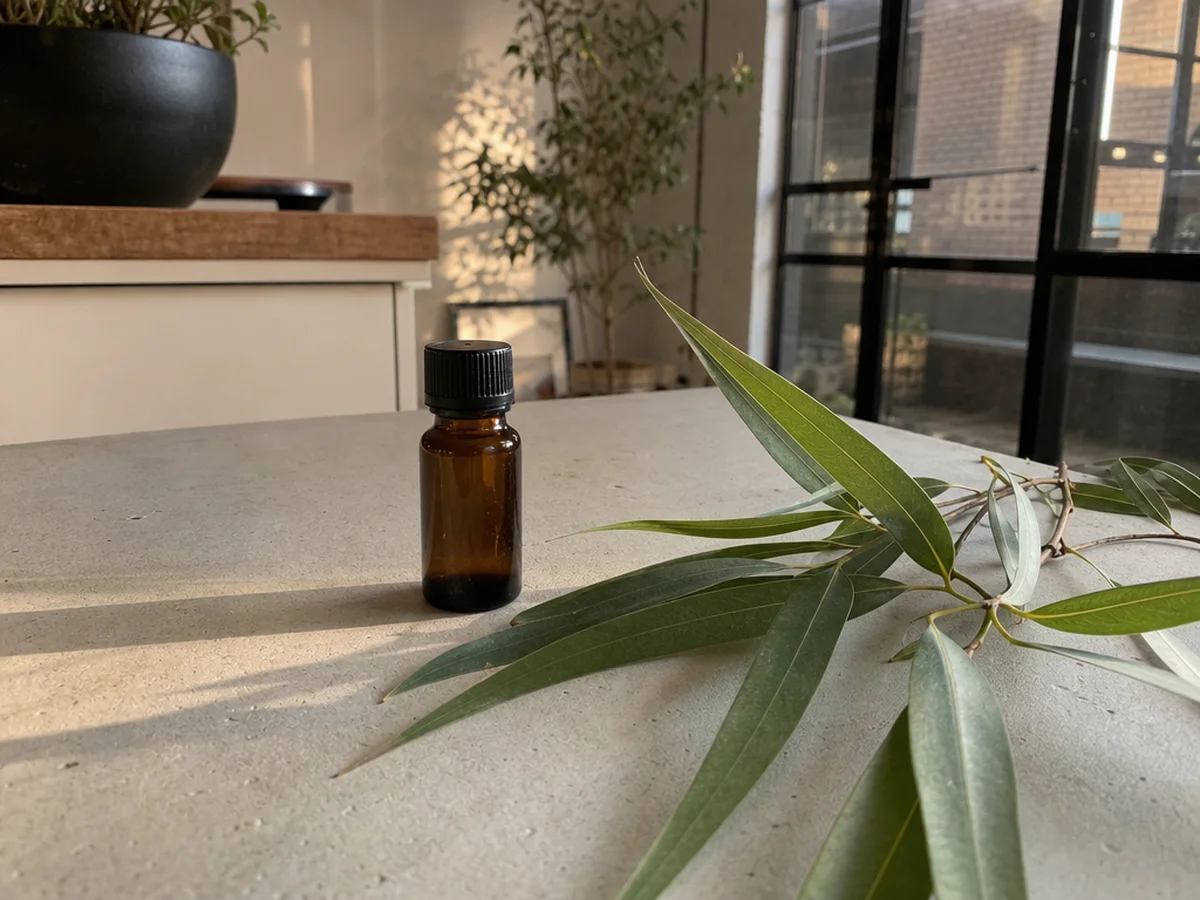
Applying that to our subject is our own inference, but a sensible one: a report listing citronellal as a share of the volatile fraction can't, on its own, rule out a carrier. Your nose helps less than you would think too, since a real leaf oil can smell a little different from lot to lot because the leaf differed.
Our own listing, read the same way
We sell one oil, the steam-distilled leaf oil of the lemon-scented gum, in ten sizes from 0.5 oz bottles to 400 lb containers, all the same oil and sold neat. Our shop table lists the botanical name as Eucalyptus citriodora, while our descriptions use the current name, Corymbia citriodora; per ISO 3044:2020, they are the same tree. For anything beyond that, such as batch documentation, the botanical name confirmed in writing, or the citronellal character of a lot, ask us in writing through the contact page before you rely on any figure. We'd encourage you to put the same questions to any supplier.
Questions that make a good conversation
A good seller likes being asked questions. Keep your list short and friendly: What is the botanical name and plant part? What is the size of this bottle and is anything else in it? Can you tell me about this particular lot? You are not interrogating anyone. You are simply showing that you care about the product, and a seller who cares about it too will be glad to talk.

Write the answers down next to the date you received the bottle. A small label on the cap or a line in a notebook is plenty, and it saves you from relying on memory a year from now.
Checks that cost nothing when the bottle arrives
- Write the date you received it on the bottle. The Tisserand Institute advises noting the purchase or opening date.
- Compare it with a fresh reference if you have one. The Institute says the change in smell is easy to miss unless you compare with a new, fresh oil.
- Keep it capped, cool and dark. Heat, light and moisture speed oxidation, and most oils keep at least one to two years before it becomes noticeable.
If answers from a seller come back vague, order the smallest size first; our first-bottle guide explains sizing, and the shopper's checklist covers what to ask. Our quality article goes further on what GC/MS reports show.
Read the label for what the seller claims, use a document for what the lot is, and use your own nose for what you like. Each answers a different question, and together they make a confident purchase.
Lemon Eucalyptus Essential Oil
Lemon Eucalyptus Essential Oil from our own shop, in sizes from 0.5 oz to bulk.
From $9.99
Shop Now →Sources & Further Reading
- Cosmetics Labeling Guide (FDA)
- Fragrances in Cosmetics (FDA)
- Aromatherapy (FDA)
- Essential oil of Corymbia citriodora (Hook.) K.D. Hill & L.A.S. Johnson (syn. Eucalyptus citriodora Hook) (ISO 3044:2020, via AFNOR)
- Adulteration of Essential Oils: A Multitask Issue for Quality Control. Three Case Studies: Lavandula angustifolia Mill., Citrus limon (L.) Osbeck and Melaleuca alternifolia (Maiden & Betche) Cheel (Capetti et al., 2021)
- Corymbia citriodora: a valuable resource from Australian flora for the production of fragrances, repellents, and bioactive compounds (Goodine and Oelgemoeller, 2020)
- Is my bottle of essential oil oxidized or no longer good to use? (Tisserand Institute)
- Mosquitoes, Ticks, and Other Arthropods (CDC Yellow Book 2026 Edition)